How to Join Solar Panels?
How to join solar panels? Solar panels can be joined by connecting them in series or parallel configurations using proper solar cables, connectors, and wiring methods to match system voltage and power requirements.
Connecting multiple solar panels is a key step when building solar power for your home or expanding an existing photovoltaic system. The wiring method affects voltage, current, inverter compatibility, and overall system performance.
At Bright Solar, we work with different solar applications, including residential systems, portable solar solutions, and flexible solar panels. During real installation discussions, we often find that customers focus on panel wattage but overlook one important detail: the way panels are connected can change how the entire system performs.Visit the product page:Flexible Solar Panels
Two identical 200W solar panels can produce very different system characteristics depending on whether they are connected in series, parallel, or a combination of both.
Understanding Solar Panel Connections
Why Do Solar Panels Need to Be Joined?
A single solar panel may not provide enough voltage or power for many applications.
By joining multiple panels together, homeowners and installers can:
- Increase system voltage
- Increase charging current
- Match inverter requirements
- Build larger solar energy systems
- Improve energy production capacity
For example:
A residential solar system may require several panels connected together to reach the voltage range needed by a solar inverter.
The connection method is not simply about adding more panels. It is about designing the electrical characteristics correctly.
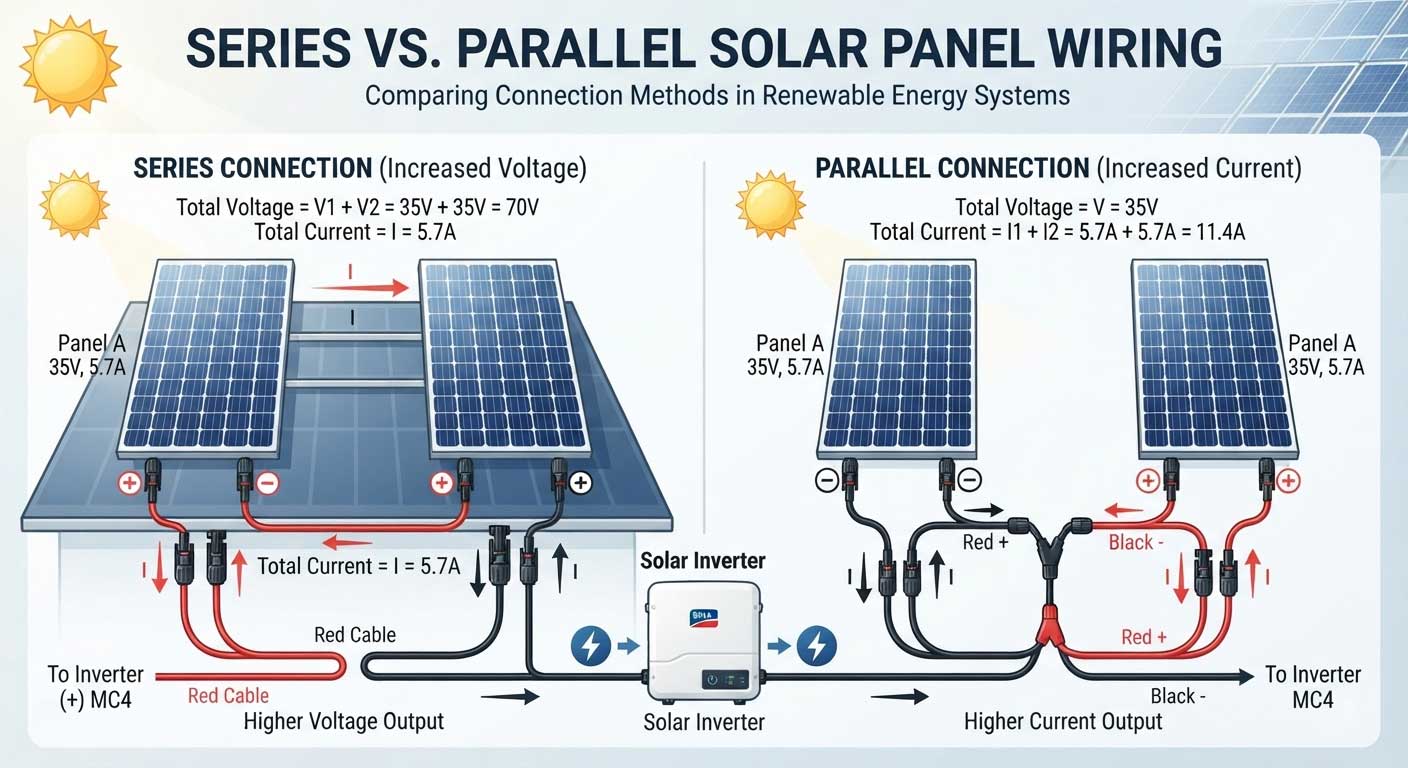
Solar Panel Series vs Parallel Connection
Connecting Solar Panels in Series
When solar panels are connected in series:
- Voltage increases
- Current remains the same
The positive terminal of one panel connects to the negative terminal of the next panel.
Example:
Two 400W solar panels:
| Connection | Voltage | Current | Power |
|---|---|---|---|
| One panel | 40V | 10A | 400W |
| Two panels in series | 80V | 10A | 800W |
Advantages:
- Higher voltage output
- Lower current losses
- Suitable for longer cable distances
- Common for grid-connected systems
However, shading can affect series-connected panels because current flow depends on the weakest panel.
Connecting Solar Panels in Parallel
How Parallel Solar Wiring Works
Parallel connections combine the current output while keeping voltage similar.
The positive terminals connect together, and the negative terminals connect together.
Example:
Two 400W solar panels:
| Connection | Voltage | Current | Power |
|---|---|---|---|
| One panel | 40V | 10A | 400W |
| Two panels parallel | 40V | 20A | 800W |
Advantages:
- Better performance when some panels receive different sunlight
- Keeps system voltage lower
- Useful for off-grid solar applications
However, larger current requires thicker cables and proper protection equipment.
How to Join Solar Panels Step by Step
Step 1: Check Solar Panel Specifications
Before wiring panels together, check:
- Maximum power voltage (Vmp)
- Open circuit voltage (Voc)
- Maximum current (Imp)
- Short circuit current (Isc)
Panels connected together should have compatible electrical characteristics.
Step 2: Choose Series or Parallel Wiring
Select the connection based on your system requirements.
Use series connection when:
- Higher voltage is needed
- Cable distance is longer
- Inverter supports higher input voltage
Use parallel connection when:
- More current is needed
- Voltage must remain stable
- Using lower-voltage battery systems
Step 3: Connect Solar Panels Using MC4 Connectors
Most modern solar panels use MC4 connectors.
Basic connection:
- Connect panel positive (+) to the next panel negative (-) for series wiring.
- Connect matching positive and negative terminals together for parallel wiring.
- Verify polarity before connecting equipment.
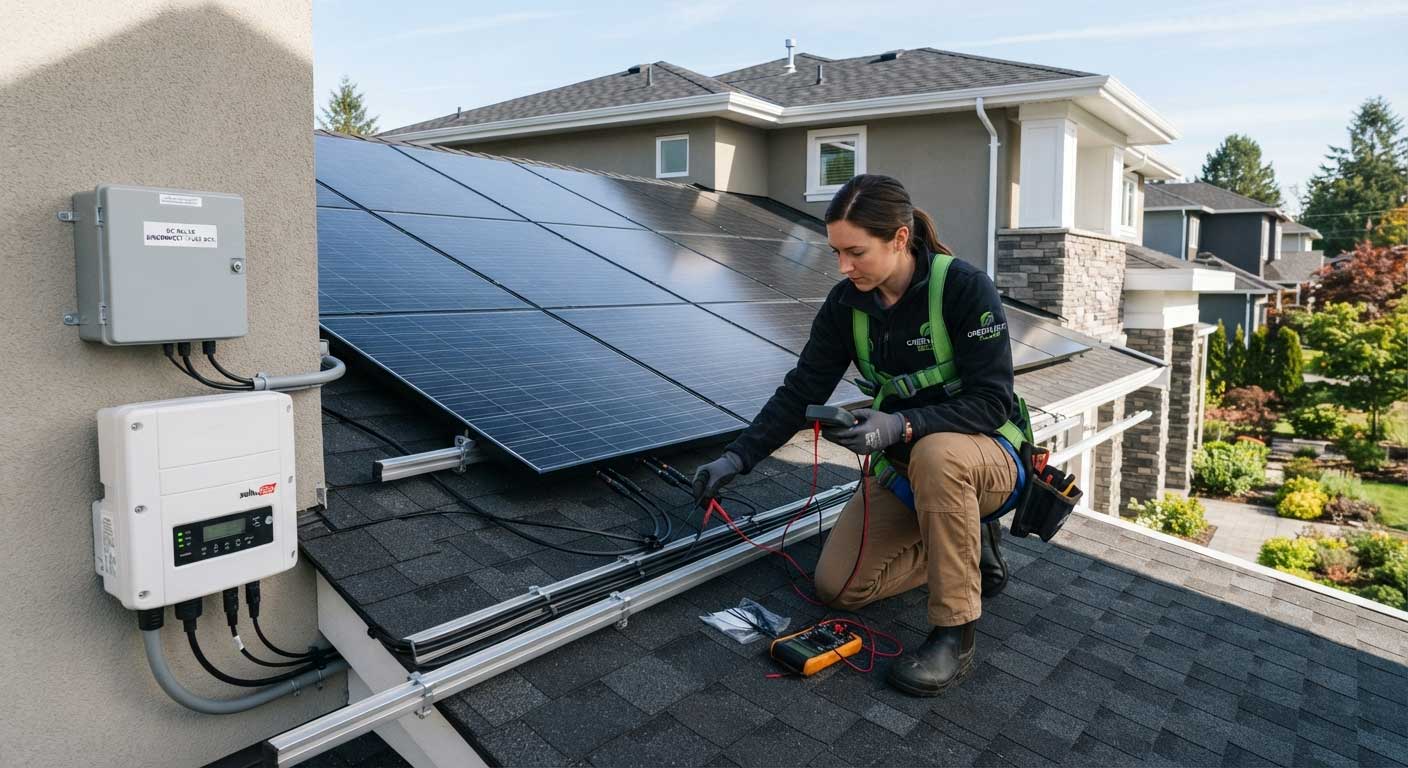
- Test voltage with a multimeter.
Incorrect polarity can damage controllers, inverters, or other components.
How to Install Solar Panels for Home Systems
Wiring Considerations Before Installation
For solar panels for your home, connection planning should happen before mounting panels.
Consider:
Roof Layout
The number and position of panels affect wiring options.
Inverter Requirements
Different inverters have different:
- Voltage ranges
- Maximum current limits
- MPPT inputs
Cable Distance
Long cable runs create voltage losses.
The National Renewable Energy Laboratory (NREL) recommends proper system design and electrical considerations to improve photovoltaic system performance and reliability.
Source: National Renewable Energy Laboratory (NREL)
Bright Solar Installation Experience
At Bright Solar, we have worked with different solar configurations, from compact portable systems to larger custom solar solutions.
One common mistake we see is choosing the connection method based only on the number of panels.
A customer may say:
“I have four panels, so I just connect them together.”
But the correct answer depends on:
- Battery voltage
- Charge controller type
- Inverter specifications
- Installation environment
Solar wiring is a system design decision, not just a cable connection task.
Series-Parallel Solar Panel Connection for Larger Systems
For larger solar panels for your home projects, installers often use a combination of series and parallel wiring.
This method is called a series-parallel connection.
It works like this:
- Several panels are connected in series to increase voltage.
- Multiple series strings are connected in parallel to increase current.
This approach is common in residential and commercial solar arrays because it allows designers to balance inverter voltage requirements, current limits, and available roof space.
Example:
Four 400W solar panels:
Option A: All panels in series
- Voltage increases significantly
- Current stays unchanged
Option B: Two panels in series + another two panels in series, then parallel the two strings
- Voltage increases
- Current increases
- Better flexibility for larger systems
This is often the configuration used when installing solar energy for home because it provides a practical balance between performance and equipment limitations.
Common Mistakes When Joining Solar Panels
Mixing Different Solar Panels
One mistake I often see during system reviews is combining panels with very different specifications.
Avoid connecting panels with large differences in:
- Wattage
- Voltage
- Current rating
- Solar cell technology
For example, connecting a 100W panel with a 400W panel in the same string can reduce overall performance because the lower-performing panel may limit the current output.
Ignoring Voltage Limits
Every inverter and charge controller has a maximum input voltage.
Before connecting panels, check:
- Open circuit voltage (Voc)
- Maximum system voltage
- MPPT operating range
- Maximum input current
Exceeding these values can permanently damage equipment.
Solar panel wiring guides consistently emphasize that series connections increase voltage while parallel connections increase current, making correct system matching essential.
Using Incorrect Cable Sizes
Solar cables carry DC electricity from the panels to the controller or inverter.
Cable selection depends on:
- Current flow
- Cable length
- Voltage
- Installation environment
A cable that is too small can create:
- Energy losses
- Excess heat
- Reduced system efficiency
For residential solar installations, professional installers usually calculate voltage drop before selecting cable size.
How to Join Solar Panels Safely
Solar Panel Wiring Checklist
Before connecting your solar array:
1. Turn Off Equipment
Disconnect:
- Battery connections
- Inverter input
- Charge controller input
Never connect live solar circuits without proper precautions.
2. Confirm Panel Polarity
Use a multimeter to check:
- Positive terminal
- Negative terminal
- Expected voltage output
Reverse polarity can prevent charging and damage sensitive equipment.
3. Use Quality Connectors
Most modern modules use MC4-style connectors.
Good connectors should provide:
- Waterproof connection
- UV resistance
- Stable electrical contact
Poor-quality connectors are one of the hidden causes of solar system failures.
Bright Solar Practical Installation Insight
When designing solar systems, we usually start with the electrical target rather than the number of panels.
A better question is not:
“How many solar panels can I connect?”
The better question is:
“What voltage and current does my system need?”
For example, a small off-grid cabin, RV setup, and residential rooftop system may use the same 400W panels but require completely different wiring designs.
This is why professional solar power installation planning matters.
At Bright Solar, we evaluate:
- Application environment
- Available installation area
- Battery voltage
- Controller type
- Expected energy demand
before recommending a connection method.
FAQ About How to Join Solar Panels?
Can I connect solar panels together myself?
Yes, basic connections such as joining compatible panels in series or parallel are possible. However, larger systems should follow electrical codes and manufacturer specifications.
Is series or parallel better for solar panels?
Neither method is always better. Series connections increase voltage, while parallel connections increase current. The best option depends on your inverter, battery system, and installation conditions.
Can I connect different watt solar panels together?
It is possible in some situations, but mixing different panels can reduce system performance. Matching voltage and current specifications is recommended.
How many solar panels can be connected together?
The number depends on:
- Inverter voltage limit
- Charge controller capacity
- Panel specifications
- System design requirements
There is no universal maximum number.
Do solar panels need an inverter after connection?
For home electricity use, yes. Solar panels produce DC electricity, while most household appliances use AC power. An inverter converts DC electricity into usable AC power.
Can solar panels be connected directly to batteries?
Some small systems can use a charge controller between panels and batteries. Direct connection without protection is generally not recommended because charging voltage must be controlled.
Final Thoughts: Building the Right Solar Panel Connection
Learning how to join solar panels is not only about connecting positive and negative wires.
The correct wiring method determines:
- System voltage
- Current output
- Energy losses
- Equipment safety
- Long-term reliability
For small projects, series or parallel wiring may be enough. For complete solar panels for your home systems, a carefully designed combination of both usually delivers better results.
A properly connected solar array allows your panels to operate closer to their intended performance and helps create a reliable renewable energy system.
The prev: How to Mount Solar Panels on Roof?The next: How Are Solar Panels Installed?
Related recommendations
-

do solar panels give off radiation?
197do solar panels give off radiation? Learn whether solar panels produce harmful radiation, electromagnetic fields, and what science says about solar energy safety.
View details -
How Long Do Solar Panels Last?
161Learn how long do solar panels last, what affects solar lifespan, degradation rates, and real-world durability data from long-term solar installations.
View details -
are portable solar panels any good?
224Are portable solar panels any good for camping, RVs, and backup power? Discover real-world performance, charging speed, and expert insights from Bright Solar.
View details -
How to Install Flexible Solar Panels on RV?
220Learn how to install flexible solar panels on RV roofs safely and efficiently. Expert RV installer tips, wiring advice, airflow methods, and real-world solar insights.
View details