How to Attach Flexible Solar Panel to RV Roof?
How to Attach Flexible Solar Panel to RV Roof?
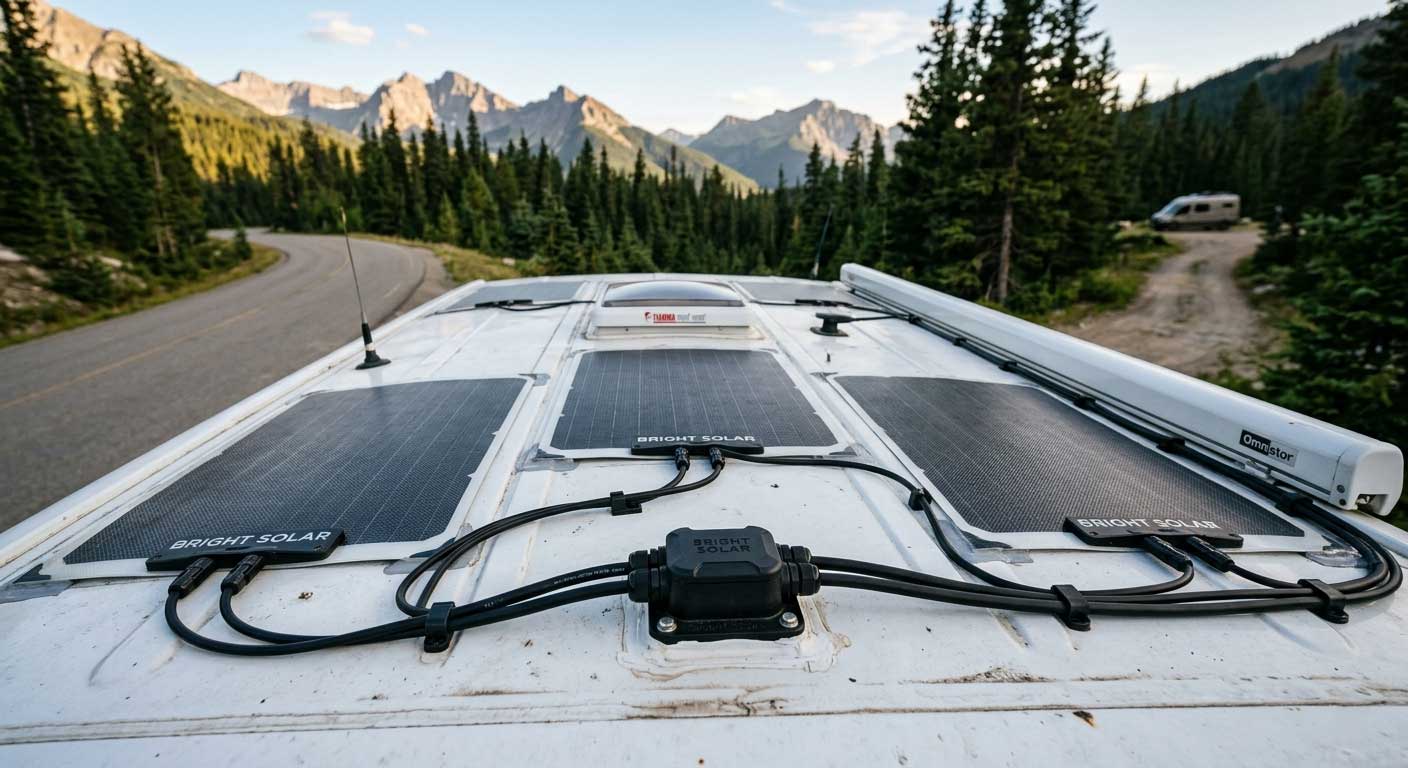
To attach a flexible solar panel to an RV roof, clean the surface thoroughly, position the panel carefully, apply marine-grade adhesive or hybrid mounting hardware, seal cable entry points, and leave slight airflow underneath. Proper installation prevents water leaks, heat buildup, and premature panel failure.
I’ve seen flexible panels survive years on motorhomes crossing Arizona, Utah, and Baja coastlines. I’ve also seen brand-new panels peel off within one summer because someone used cheap silicone from a hardware store.
The panel matters. But the installation usually decides whether it lasts five years or fifteen.
Why RV Roof Installations Are Different
An RV roof is not a stationary rooftop.
It flexes while driving. It vibrates continuously. It expands under heat. Wind pressure changes every hour on the highway.
That movement changes how flexible solar panels should be mounted.
According to the U.S. Department of Energy, rooftop surfaces exposed to direct summer sunlight can exceed 149°F (65°C).
Source:
https://www.energy.gov/
Dark RV roofs often run even hotter.
Flexible panels installed without airflow underneath can reach temperatures high enough to accelerate adhesive failure and cell degradation.
I learned this during a Nevada overlanding project where roof temperatures measured nearly 176°F (80°C) around midday. The adhesive softened before the panel itself showed any electrical issues.
Preparing the RV Roof Before Installation
Most installation mistakes happen before the panel even touches the roof.
A flexible panel should never be mounted onto:
- Dusty surfaces
- Waxed fiberglass
- Wet roofing
- Loose paint
- Old silicone residue
Even strong adhesive will eventually fail on contaminated surfaces.
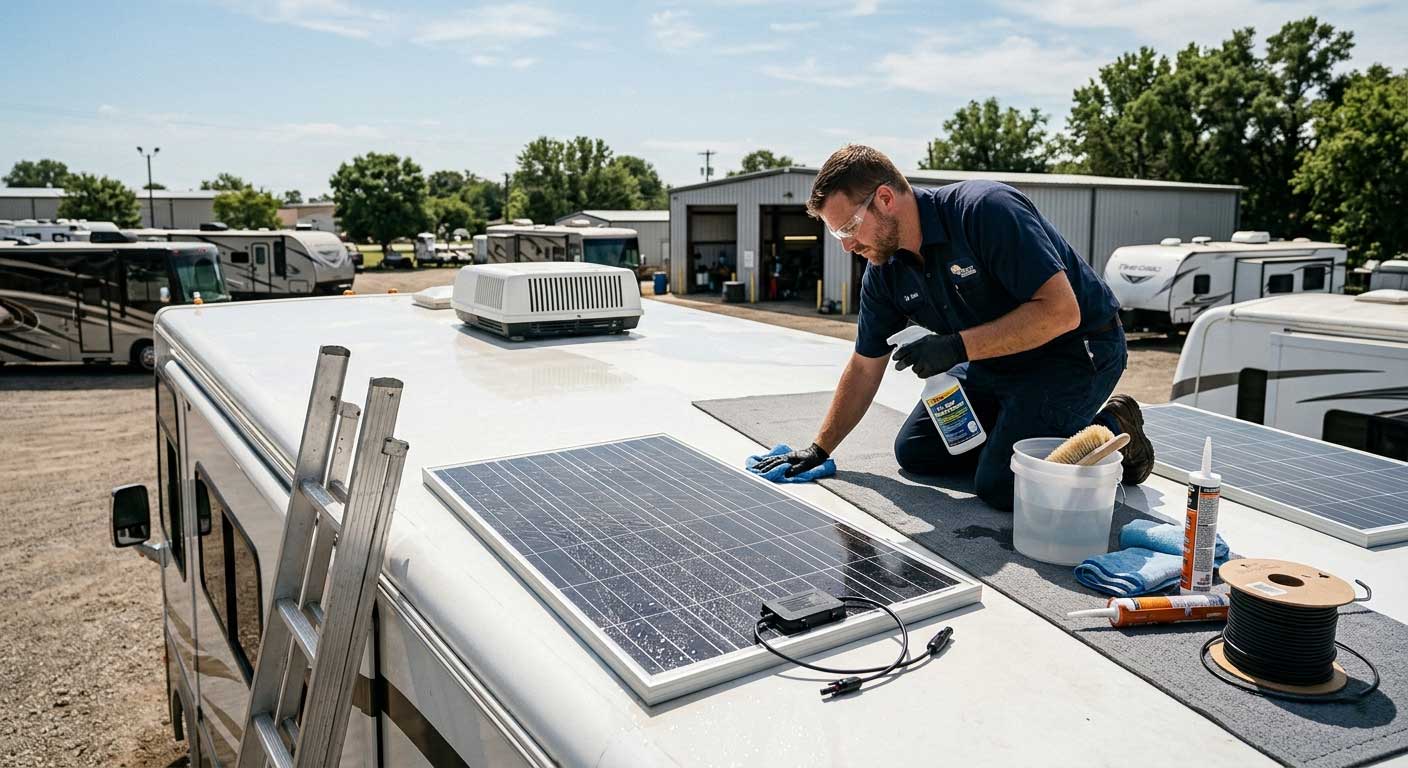
Step-by-Step Roof Preparation
1. Wash the Roof
Remove dirt, oxidation, and loose debris.
2. Degrease Thoroughly
Use isopropyl alcohol instead of household cleaners.
3. Dry Completely
Moisture trapped under adhesive creates long-term problems.
4. Check Surface Flatness
Avoid sharp ridges or uneven mounting zones.
Best Ways to Attach Flexible Solar Panels to an RV Roof
There are three common methods.
Each works differently depending on climate, RV type, and road conditions.
Method 1 — Marine-Grade Adhesive Mounting
This is the most common approach for lightweight flexible panels.
Popular adhesives include:
- Sikaflex 252
- 3M 5200
- Dekasyl MS-5
These products tolerate:
- UV exposure
- Roof vibration
- Thermal expansion
- Moisture exposure
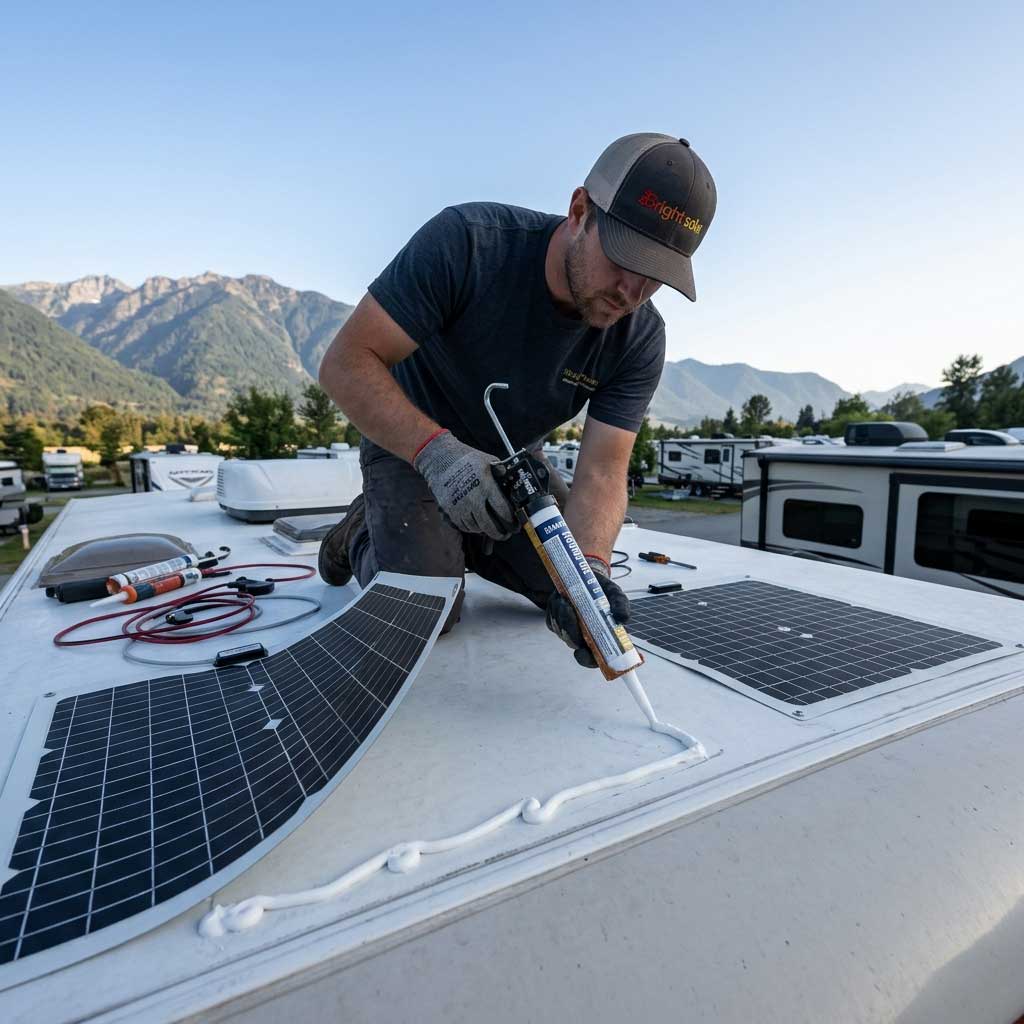
How Adhesive Mounting Is Done
Most experienced installers:
- Apply adhesive in strips, not full coverage
- Leave slight airflow gaps
- Avoid excessive pressure
- Allow full cure time before driving
That airflow detail matters more than people think.
A completely sealed panel traps heat aggressively.
Method 2 — Screw Mounting
Some RV owners still prefer mechanical fasteners.
Advantages:
- Better wind resistance
- Stronger fixation for off-road use
- Easier future replacement
Disadvantages:
- Roof penetration risk
- Waterproof sealing becomes critical
- Potential corrosion around hardware
Personally, I avoid excessive drilling on fiberglass RV roofs unless absolutely necessary.
Method 3 — Hybrid Mounting
This is my preferred method for long-distance RV travel.
Combination setup:
- Marine adhesive underneath
- Limited perimeter screws
- Edge sealing compound
That balance handles highway vibration far better over time.
Why Heat Management Matters
Heat is one of the biggest silent killers of flexible solar panels.
According to the National Renewable Energy Laboratory (NREL), solar module efficiency decreases as operating temperatures rise above standard testing conditions.
Source:
https://www.nrel.gov/
On RV roofs, trapped heat becomes much worse because:
- Airflow is limited
- Roof materials store heat
- Flexible panels sit close to the surface
I’ve inspected RV installations where the roof underneath became hotter than the panel itself.
That heat affects:
- Adhesive lifespan
- Power output
- EVA encapsulation
- Cable durability
How to Reduce Heat Buildup
Good installers usually:
- Leave small edge ventilation gaps
- Avoid full-surface adhesive
- Use reflective RV roof coatings
- Keep junction boxes elevated
Tiny airflow improvements make a surprisingly large difference.
Cable Routing and Waterproofing
The electrical side of RV solar installation gets ignored too often.
A clean-looking panel means nothing if water leaks through the cable entry point.
Best Practices for RV Solar Wiring
Use:
- UV-resistant solar cable
- Waterproof MC4 connectors
- Roof cable glands
- Fuse protection
- Strain relief clips
Avoid household extension cables completely.
I once saw an RV owner route solar cable through a partially sealed bathroom vent. It worked for eight months. Then the roof insulation started absorbing water during monsoon season.
The repair cost exceeded the solar system itself.
Common Installation Mistakes
Some failures repeat constantly.
Using Cheap Silicone
Standard household silicone degrades quickly under UV exposure and thermal cycling.
Marine-grade adhesive exists for a reason.
Installing on Dirty Surfaces
Dust and wax weaken bonding strength dramatically.
Blocking Drainage Paths
Water pooling around panel edges speeds up roof deterioration.
Overtightening Flexible Panels
Flexible panels still contain fragile solar cells.
Too much bending pressure creates microcracks.
How Long Will a Proper RV Installation Last?
Realistically:
- Budget flexible panels: 5–8 years
- Quality ETFE flexible panels: 10–15 years
- Poor installations: sometimes less than 3 years
Installation quality often matters more than the panel brand itself.
That surprises many first-time RV owners.
Best RV Applications for Flexible Solar Panels
Flexible panels work especially well on:
- Camper vans
- Class B RVs
- Curved fiberglass roofs
- Lightweight overlanding builds
- Marine-RV hybrid systems
They are less ideal for:
- Large Class A energy-heavy systems
- Permanent high-output off-grid arrays
- Extremely high-wind commercial applications
FAQ:How to Attach Flexible Solar Panel to RV Roof?
Can I glue a flexible solar panel directly to my RV roof?
Yes. Marine-grade adhesive is commonly used for RV installations, but proper surface preparation and ventilation spacing are essential.
What adhesive is best for RV flexible solar panels?
Sikaflex 252 and 3M 5200 are widely trusted because they resist vibration, moisture, and UV exposure.
Do I need screws for flexible solar panels?
Not always. Many RV owners use adhesive-only installations successfully, especially for lightweight panels.
Can flexible solar panels damage an RV roof?
Improper installation can trap heat or moisture, which may damage roofing materials over time.
Should flexible solar panels have airflow underneath?
Yes. Even minimal airflow helps reduce operating temperatures and extends panel lifespan.
Final Thoughts
Learning how to attach flexible solar panel to RV roof properly is really about controlling movement, heat, moisture, and vibration over thousands of miles.
The installation details that nobody notices on day one become the reason systems either survive or fail years later.
At Bright Solar, we’ve watched well-installed flexible panels continue producing stable power after years of road vibration, coastal humidity, and desert heat. We’ve also replaced panels that were technically “high quality” but mounted carelessly.
The difference usually comes down to patience during installation.
Not speed.
Related recommendations
-

will hail damage solar panels?
151will hail damage solar panels? Learn how hail affects PV modules, what hail sizes can cause damage, how to choose stronger panels, and what to inspect after storms.
View details -
How Do Solar Panels Work at Night?
132How do solar panels work at night? Learn how solar systems use batteries, grid power, and energy storage solutions to provide electricity after sunset.
View details -
How Much For Solar Panels On House?
94How much for solar panels on house? Learn average home solar costs, installation factors, equipment pricing, and investment considerations with Bright Solar.
View details -
How many amps does 300 watt solar panel produce?
184How many amps does 300 watt solar panel produce? Learn solar panel amp calculations, voltage effects, current output, and real-world solar performance.
View details