How do you convert solar energy into electricity?
How do you convert solar energy into electricity?
Solar energy is converted into electricity through the photovoltaic effect, where solar cells absorb sunlight and create direct current (DC) electricity. An inverter then converts DC power into alternating current (AC) electricity for homes and businesses.
At Bright Solar, I have worked with different solar modules and system designs for residential, RV, and off-grid applications. When explaining solar technology to customers, I often start with the actual energy path: sunlight enters the solar cell, electrical charges move through the circuit, and usable electricity reaches appliances.
The process may happen in seconds, but every component plays a role in making solar power reliable.
How does a solar panel convert sunlight into electricity?
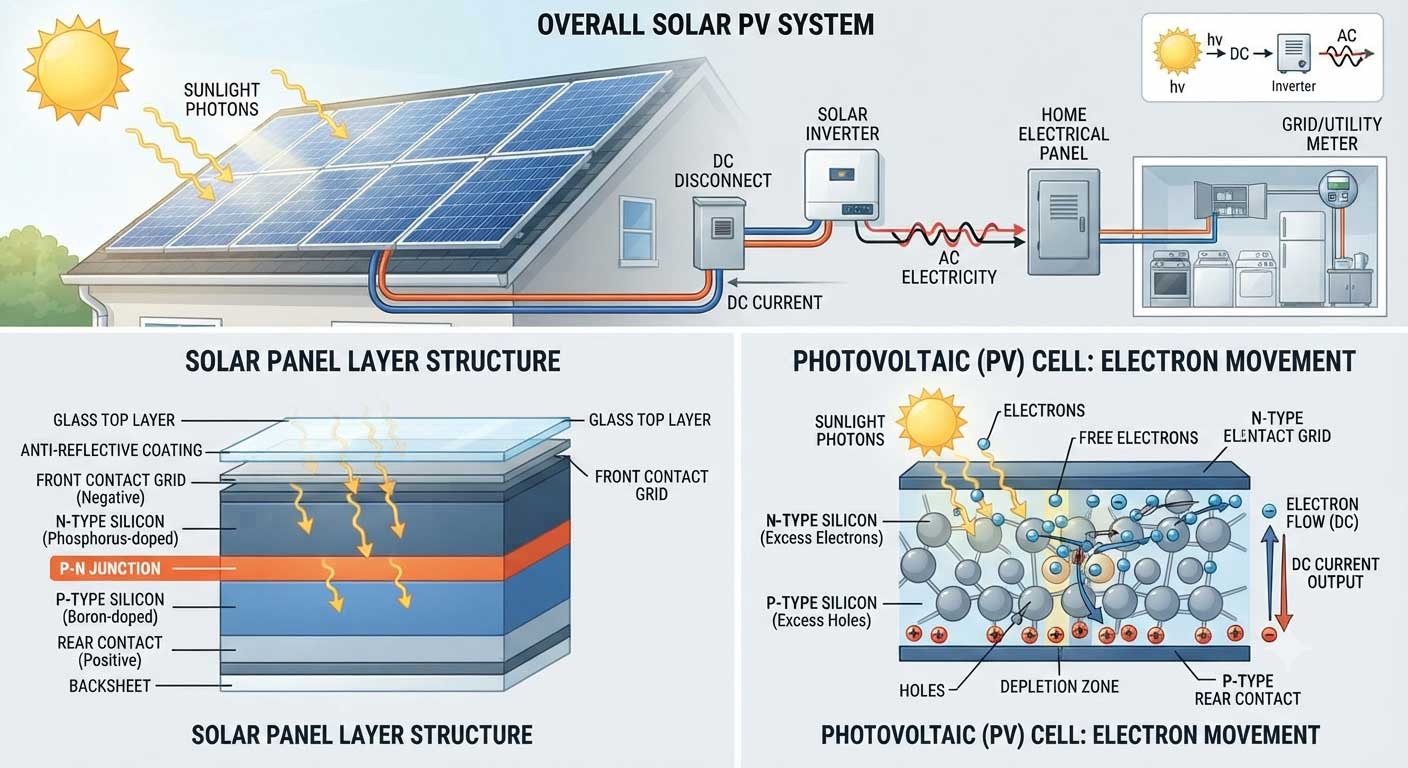
The conversion process begins inside photovoltaic (PV) cells.
Solar panels contain many interconnected solar cells, usually made from semiconductor materials such as silicon.
The basic process:
- Sunlight reaches the solar panel surface.
- Photons from sunlight hit the solar cells.
- Electrons inside the semiconductor material become energized.
- Electrical current begins flowing.
- The generated DC electricity moves through wiring to the next component.
This reaction is called the photovoltaic effect.
According to U.S. Department of Energy Solar Photovoltaic Cell Basics, photovoltaic cells generate electricity by converting sunlight directly into electrical energy through semiconductor materials.
A solar panel does not “store” sunlight. Instead, it continuously converts available solar radiation into electrical power while light reaches the cells.
What happens inside a photovoltaic solar cell?
A photovoltaic cell works similarly to a semiconductor device.
A typical solar cell contains:
- Positive and negative silicon layers
- Electrical contacts
- Anti-reflective coating
- Protective glass layer
When sunlight hits the cell:
Photon absorption
Sunlight contains tiny energy particles called photons. When photons hit the silicon layer, they transfer energy to electrons.
Electron movement
The energy pushes electrons into motion, creating an electric current.
Current collection
Metal contacts collect the moving electrons and direct electricity through external circuits.
The result is direct current electricity, also known as DC power.
A single solar cell produces only a small amount of voltage. Multiple cells are connected together to create a practical solar module.
Why do solar panels produce DC electricity?
Solar cells naturally produce DC electricity because electrons flow in one consistent direction through the circuit.
DC electricity characteristics:
- Current flows in one direction
- Commonly used for batteries
- Generated directly by photovoltaic cells
However, most homes use AC electricity.
Household appliances such as:
- Refrigerators
- Air conditioners
- TVs
- Washing machines
are designed to operate using alternating current.
Therefore, solar systems require an inverter to make solar electricity usable for everyday applications.
How does an inverter convert solar energy into usable electricity?
The inverter is one of the most important parts of a solar power system.
The conversion process:
Solar Panel → DC Electricity → Inverter → AC Electricity → Home Appliances
The inverter changes:
DC power (from solar panels)
into:
AC power (used by household electrical systems)
Modern solar inverters also provide:
- Power monitoring
- System protection
- Voltage regulation
- Grid connection management
A typical residential solar system includes:
| Component | Function |
|---|---|
| Solar Panels | Capture sunlight and create DC electricity |
| Charge Controller | Regulates battery charging |
| Battery | Stores excess energy |
| Inverter | Converts DC electricity to AC power |
| Electrical Panel | Distributes electricity |
The National Renewable Energy Laboratory (NREL) Photovoltaic Research Program explains that photovoltaic system performance depends not only on solar modules but also on balance-of-system components such as inverters and electrical equipment.
How efficient is solar energy conversion?
Solar panel efficiency describes how much sunlight energy is converted into usable electricity.
For example:
If solar radiation provides:
1000 watts of solar energy
and a panel converts:
220 watts into electricity
The panel efficiency is:
22%
Modern commercial solar panels typically achieve approximately:
- 18–23% efficiency for many residential modules
- Higher efficiency for premium technologies
Efficiency depends on:
- Solar cell technology
- Temperature
- Installation angle
- Sunlight intensity
- Manufacturing quality
A higher-efficiency panel does not always mean more total energy if installation conditions are poor. In real projects, correct placement often matters as much as the panel specification.
What happens to solar electricity after it leaves the panel?
After electricity leaves the solar panel, it follows several possible paths.
Grid-connected solar system
Electricity flows:
Solar panels → inverter → home electrical panel → appliances
Extra electricity may be sent back to the utility grid depending on local regulations.
Off-grid solar system
Electricity flows:
Solar panels → charge controller → battery → inverter → appliances
Energy is stored for nighttime or cloudy periods.
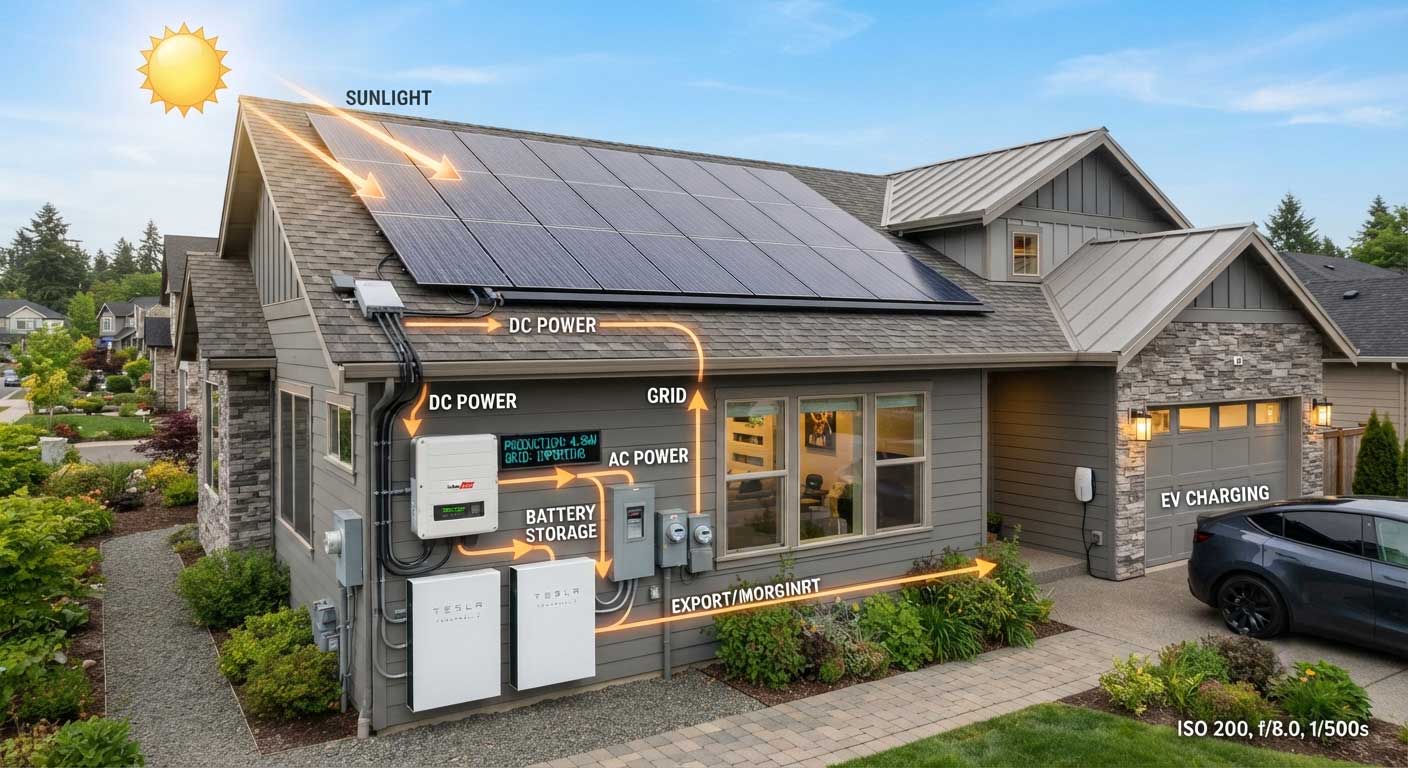
Hybrid solar system
A hybrid system combines:
- Solar generation
- Battery storage
- Grid connection
This provides more flexibility during power outages.
How long does it take for solar energy to become electricity?
The physical conversion of sunlight into electricity happens almost instantly when photons reach solar cells.
However, delivering usable electricity involves multiple steps:
- Sunlight reaches the solar panel.
- PV cells generate DC electricity.
- Electrical wiring transfers power.
- Inverter converts DC into AC.
- Appliances receive electricity.
The complete process occurs continuously while the solar system receives sunlight.
In practical installations, the main challenge is not the conversion speed but maintaining stable production throughout changing weather conditions.
What factors affect solar energy conversion efficiency?
Although the photovoltaic process is straightforward, real-world electricity production depends on many external conditions.
During solar system evaluations, I usually look beyond the panel specification sheet. A 400W module on a shaded roof can produce less energy than a smaller panel installed in ideal conditions.
The main factors affecting conversion include:
Sunlight intensity
More sunlight generally means more electricity production.
Factors include:
- Geographic location
- Season
- Weather conditions
- Cloud coverage
A solar panel installed in an area with five peak sun hours per day will normally generate more energy than the same panel installed in an area with fewer sunlight hours.
Temperature
Solar panels work best at moderate temperatures.
High temperatures can reduce voltage output because semiconductor materials become less efficient when overheated.
This is why proper airflow behind rooftop panels can improve performance.
Solar panel orientation
The angle and direction of installation affect how much sunlight reaches the solar cells.
Important considerations:
- Roof direction
- Tilt angle
- Nearby shading
- Seasonal sun position
A correctly positioned solar panel captures more available sunlight throughout the day.
Solar panel quality
Different solar technologies have different performance levels.
Common solar cell types:
| Solar Cell Type | Characteristics |
|---|---|
| Monocrystalline | High efficiency, widely used in homes |
| Polycrystalline | Lower cost, slightly lower efficiency |
| Thin-film | Lightweight and flexible |
Bright Solar focuses on high-quality photovoltaic solutions where efficiency, durability, and application requirements work together.
Can solar energy be converted directly into electricity without batteries?
Yes, solar energy can be converted directly into electricity without batteries.
A grid-connected solar system can operate like this:
Solar Panels → Inverter → Home Electrical System
During daylight hours, electricity generated by solar panels can immediately power appliances.
Batteries are only required when users need:
- Backup electricity
- Nighttime solar power
- Off-grid operation
- Energy independence
Many residential systems today operate without batteries because the utility grid provides backup power when solar production is unavailable.
How does solar energy power a house?
A complete home solar system follows a simple energy pathway:
Sunlight → Solar Panels → DC Electricity → Inverter → AC Electricity → Home Appliances
Example:
Morning:
- Solar panels begin generating electricity
Afternoon:
- Solar production reaches its highest level
Evening:
- Solar production decreases
- Grid power or batteries provide electricity
A properly designed solar system can supply electricity for:
- Lighting
- Refrigerators
- Computers
- Heating and cooling equipment
- Household electronics
The required solar capacity depends on daily electricity consumption, local sunlight conditions, and system design.
What is the role of batteries in solar electricity systems?
Batteries do not create electricity. They store electricity generated by solar panels for later use.
The energy flow becomes:
Solar panels generate electricity → Battery stores excess energy → Inverter supplies power when needed
Battery storage is useful for:
- Off-grid homes
- Remote cabins
- Emergency backup systems
- Areas with unstable electricity supply
Modern lithium batteries are commonly used because they provide:
- Higher energy density
- Longer cycle life
- Better charging efficiency
Can flexible solar panels convert sunlight into electricity?
Yes, flexible solar panels use the same photovoltaic principle as traditional rigid panels.
The difference is mainly the construction method.
Flexible solar panels use:
- Lightweight materials
- Thin photovoltaic layers
- Flexible protective surfaces
They are commonly used for:
- RV roofs
- Boats
- Camping systems
- Mobile applications
The conversion process remains the same:
Sunlight → Photovoltaic cells → DC electricity
At Bright Solar, flexible solar panels are designed for situations where weight, portability, and installation flexibility are important.Visit the product page:Flexible Solar Panels
FAQ About how do you convert solar energy into electricity?
How do you convert solar energy into electricity?
Solar energy is converted into electricity through the photovoltaic effect. Solar cells absorb sunlight, create DC electricity, and an inverter converts it into AC power.
What part of a solar panel creates electricity?
The photovoltaic cells inside the solar panel create electricity when sunlight activates electrons in semiconductor materials.
Do solar panels produce AC or DC electricity?
Solar panels produce DC electricity. An inverter converts DC electricity into AC electricity for household use.
Can solar panels generate electricity at night?
No. Solar panels require sunlight to generate electricity. Battery storage or grid power can provide electricity at night.
How efficient are solar panels at converting sunlight into electricity?
Most modern residential solar panels convert approximately 18–23% of sunlight energy into electricity, depending on technology and conditions.
Do solar panels need batteries to work?
No. Grid-connected systems can operate without batteries. Batteries are mainly used for backup and off-grid applications.
What equipment is needed to convert solar energy into electricity?
A complete system usually requires solar panels, an inverter, electrical wiring, mounting equipment, and optionally batteries.
How Is Solar Energy Made Into Electricity?
Solar energy is made into electricity through photovoltaic cells that convert sunlight into direct current (DC) power, which an inverter changes into usable alternating current (AC) electricity for homes, businesses, and energy systems.Learn more about “How Is Solar Energy Made Into Electricity“
How Solar Energy Is Converted Into Electricity?
Solar energy is converted into electricity through the photovoltaic effect, where solar cells absorb sunlight and release electrons to create direct current (DC) electricity. An inverter then converts DC power into alternating current (AC) electricity used by homes, businesses, and electrical devices.Learn more about “How Solar Energy Is Converted Into Electricity“
Final Thoughts: How do you convert solar energy into electricity?
The answer to how do you convert solar energy into electricity starts with the photovoltaic effect. Solar panels capture sunlight and convert it into DC electricity, while inverters transform that energy into AC electricity used by homes and businesses.
From my experience working with solar applications, the most important part of a successful system is not only the panel itself but the complete design: correct sizing, proper installation, reliable components, and realistic energy expectations.
Bright Solar continues to develop solar solutions that make renewable electricity more accessible for residential, mobile, and off-grid applications.
Related recommendations
-

How to Install Flexible Solar Panel on RV Roof?
227Learn how to install flexible solar panel on RV roof safely and correctly. Discover real-world installation tips, mounting methods, wiring advice, and common mistakes to avoid.
View details -
How Much For Solar Power Home?
188How much for solar power home? Learn residential solar costs, system pricing factors, installation expenses, and expert solar solutions from Bright Solar.
View details -
How Much Energy Does a Solar Panel Produce?
293How much energy does a solar panel produce? Discover real daily and annual solar panel output, factors affecting performance, and expert insights from Bright Solar.
View details -
what does solar panels do?
243what does solar panels do? Learn how solar panels convert sunlight into electricity, reduce energy costs, support renewable power, and create a cleaner future.
View details