Will Solar Panels Work on a Cloudy Day?
Yes, solar panels will work on a cloudy day. Photovoltaic panels generate electricity from daylight, not just direct sunshine, so they can still produce power when clouds cover the sun. However, output usually decreases as cloud cover thickens, and the amount generated depends on cloud density, location, panel orientation, and system design.
How Do Solar Panels Generate Electricity on Cloudy Days?
Solar panels convert light into electricity through photovoltaic cells. Direct sunlight generally provides stronger irradiance, but some sunlight is scattered by the atmosphere and reaches the ground as diffuse daylight. Clouds reduce the amount of sunlight reaching a panel; they do not necessarily block all of it.
That is why a rooftop system may continue producing electricity during an overcast afternoon, even when the sun is not visible. The power level can fluctuate as clouds move, especially when broken cloud cover alternates between bright and dark conditions.
For homeowners and system designers, the practical question is not simply whether a panel works. It is how much energy the system can deliver under the site’s typical weather conditions.
How Much Power Do Solar Panels Produce on a Cloudy Day?
Solar output on a cloudy day varies considerably. A thin layer of cloud may cause a modest reduction, while thick storm clouds can reduce production sharply. There is no single percentage that applies to every panel or location.
The U.S. Department of Energy explains that clouds, shade, and other conditions affect the sunlight reaching a solar system and therefore its electricity production. Actual output should be estimated using local weather data and system-specific information rather than a universal cloudy-day rule.
Source:
Factors that influence cloudy-day performance
| Factor | How it affects output |
|---|---|
| Cloud thickness | Dense clouds block more sunlight than thin or scattered clouds. |
| Daylight level | Bright overcast skies can provide more usable light than very dark storm conditions. |
| Panel orientation and tilt | These affect how much available daylight reaches the modules. |
| Shading | Nearby trees, buildings, or roof features can further reduce production. |
| System condition | Dirt, damage, wiring issues, or equipment faults may add avoidable losses. |
| Local weather patterns | Frequent cloud cover changes the expected annual energy yield. |
A system that performs well in a sunny climate may produce a different annual total in a region with persistent cloud cover. For a meaningful estimate, use a solar resource or energy-yield tool that accounts for location, orientation, and weather—not just the panel’s rated wattage.
Can Solar Panels Work in Heavy Cloud or Rain?
Yes, but electricity production may be much lower. During heavy cloud cover, panels can still receive diffuse daylight, although the available energy may be limited. Rain itself does not switch off photovoltaic cells. It is the reduced light during stormy weather that usually causes the main drop in output.
Rain can also wash some loose dust from a panel surface, but it should not be treated as a substitute for inspection or cleaning where dirt, bird droppings, or other deposits remain.
What happens when clouds move across the sun?
On a partly cloudy day, output may rise and fall quickly. When a cloud passes in front of the sun, direct irradiance drops; when the sun reappears, production can increase again. System monitoring may show these changes as a jagged power curve rather than a smooth line.
What Do Real-World Data and Solar Monitoring Tell Us?
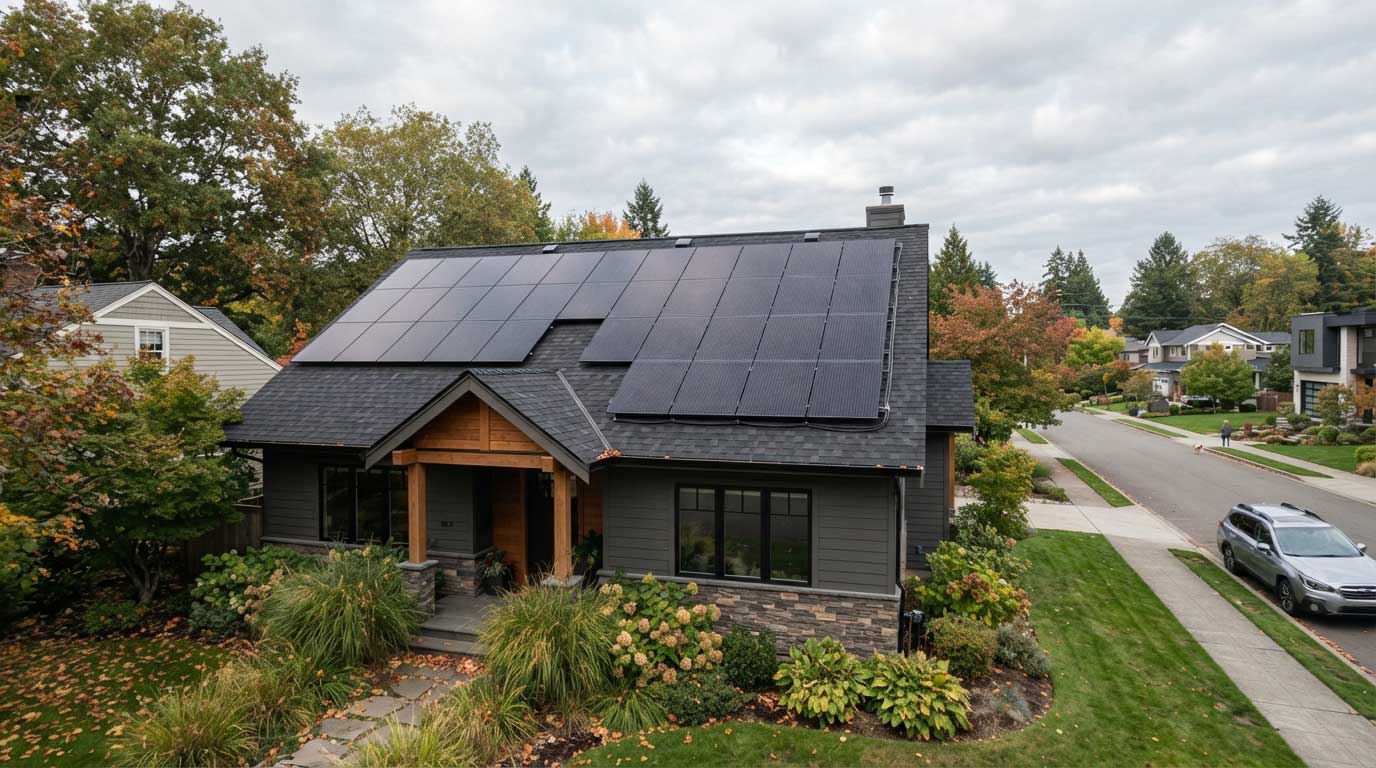
Cloudy-day performance is not a fixed percentage. The U.S. Department of Energy’s older EPA technical guide gives an illustrative range: arrays may produce around 80% of bright-sunny-day electricity under moderately cloudy skies and around 20% under heavily overcast skies. These are examples, not guaranteed outputs; modern systems and local weather can produce different results.
The National Renewable Energy Laboratory (NREL) also documents how changing cloud patterns can cause rapid fluctuations in solar power. In one analyzed case, output ranged from 15% of clear-sky power to above clear-sky levels as the cloud conditions changed. This shows why a single “cloudy-day output” figure can be misleading.
A practical way to assess a system is to compare its power curve with weather observations over multiple days. One low-output afternoon may reflect thick clouds; repeated underperformance during bright conditions may instead point to shading, soiling, wiring, or equipment issues.
How Can You Get More Solar Power on Cloudy Days?
You cannot control the weather, but you can avoid adding unnecessary losses.
- Keep panels clean: remove persistent dirt or debris using the method recommended by the manufacturer.
- Avoid avoidable shading: check nearby trees, roof features, antennas, and other obstructions.
- Use a suitable system design: confirm that the inverter, charge controller, and panel configuration match the installation.
- Monitor output over time: compare performance across similar weather and daylight conditions rather than judging by one snapshot.
- Plan for variable generation: where continuous power is essential, consider grid support, appropriate energy storage, or another backup source.
For off-grid systems, battery capacity and energy use are particularly important. Solar generation may continue in cloudy weather, but it may not cover the full load every day. Sizing should account for local solar resources, seasonal variation, and the consequences of a run of low-production days.
FAQ About Will Solar Panels Work on a Cloudy Day?
Will solar panels work on a cloudy day?
Yes. Solar panels can convert diffuse daylight into electricity even when clouds obscure the sun. Their output usually decreases as cloud cover becomes thicker.
How much electricity can solar panels produce on a cloudy day?
There is no universal percentage. Output depends on cloud thickness, daylight, location, panel orientation, shading, and system design. Published examples range widely, so use local weather and system data for a realistic estimate.
Do solar panels work when it rains?
Yes. Panels can continue generating electricity during rain if daylight reaches them. Heavy rain clouds often reduce output, but rain itself does not stop the photovoltaic process.
Do solar panels need direct sunlight to work?
No. Photovoltaic panels can use both direct and diffuse solar radiation. Direct sunlight generally produces more electricity, while diffuse daylight allows panels to generate power under cloud cover.
Will solar panels charge batteries on cloudy days?
They can, provided the panels produce enough energy and the charge controller and battery system are compatible. Charging may be slower, and the available energy may not meet the full daily demand.
Should I install solar panels in a cloudy climate?
Cloudy weather does not automatically make solar impractical. Evaluate the site’s annual solar resource, seasonal conditions, roof orientation, shading, electricity needs, and expected system cost. A location-specific yield estimate is more useful than counting cloudy days alone.
Final Answer
Will solar panels work on a cloudy day? Yes. They can generate electricity from diffuse daylight, although thick clouds and storms can reduce production significantly. With realistic energy-yield estimates, suitable equipment, and a plan for periods of low sunlight, solar can remain useful in locations that experience frequent cloud cover. Bright Solar recommends evaluating the complete application and system requirements rather than relying on rated panel power alone.
The prev: Can Solar Panels Store Energy?The next: Do Solar Panels Work in Cloudy Weather?
Related recommendations
-

How to Connect Portable Solar Panel to RV Battery?
135Connect a portable solar panel to an RV battery through a compatible charge controller, with correct polarity, fuse protection, and battery settings.
View details -
common flexible solar panel problems and how to fix them?
293Discover common flexible solar panel problems and how to fix them with real repair experience, failure analysis, maintenance tips, and practical solutions from Bright Solar.
View details -
how to calculate solar panel needs for home?
244Learn how to calculate solar panel needs for home with energy usage, sunlight hours, system losses, and panel output factors for accurate solar sizing.
View details -
How Solar Panel Works for Generate Electricity?
244How solar panel works for generate electricity explained with PV technology, solar cells, energy conversion steps, and expert insights from Bright Solar.
View details