How to Install Flexible Solar Panel on RV Roof?
How to Install Flexible Solar Panel on RV Roof?
To install a flexible solar panel on an RV roof, clean and prepare the mounting surface, position the panel for maximum sunlight exposure, secure it using approved adhesive or mounting methods, route the cables through a waterproof entry gland, and connect the system to a charge controller and battery bank.
I learned this lesson the expensive way.
About six years ago, I inspected an RV in Arizona where the owner had installed flexible solar panels himself. The wiring was fine. The solar controller was working. Yet one panel had partially lifted from the roof after a summer of desert heat.
The adhesive hadn’t failed.
The installation method had.
That experience changed how I approach RV solar installations. Flexible solar panels are lighter and easier to mount than traditional framed panels, but they are less forgiving when shortcuts are taken.
Why RV Owners Choose Flexible Solar Panels
Walk through any modern RV campground and you’ll notice something.
More rooftop solar systems are becoming nearly invisible.
Flexible panels have gained popularity because they solve several challenges traditional rigid panels create.
Common advantages include:
- Lightweight construction
- Low-profile appearance
- Reduced wind resistance
- Easier transportation
- Better fit for curved roofs
According to the U.S. Department of Energy, solar energy adoption in recreational and off-grid applications continues to expand as module efficiency improves and system costs decline.
Source:
https://www.energy.gov
For many RV owners, weight matters almost as much as power output.
A traditional framed 100W solar panel often weighs around 15-20 lbs (6.8-9 kg).
A comparable flexible panel may weigh less than 5 lbs (2.3 kg).
That difference becomes significant when multiple panels are installed.
Before You Start: Planning Matters More Than Installation
The actual mounting process often takes less time than planning.
When I arrive at RV installations, I usually spend more time measuring than drilling or wiring.
Find the Right Roof Area
Avoid placing panels near:
- Air conditioning units
- Roof vents
- Satellite antennas
- Skylights
- Roof racks
Even small shadows can dramatically reduce solar production.
According to the National Renewable Energy Laboratory (NREL), partial shading can significantly impact photovoltaic output depending on system configuration.
Source:
https://www.nrel.gov
A shadow crossing only one section of a panel can create surprisingly large energy losses.
Consider Roof Temperature
RV roofs get hotter than most people expect.
I’ve measured roof temperatures exceeding 150°F (65°C) during summer inspections in Nevada.
Heat affects both panel efficiency and adhesive performance.
This is why proper installation isn’t simply about sticking a panel onto a roof.
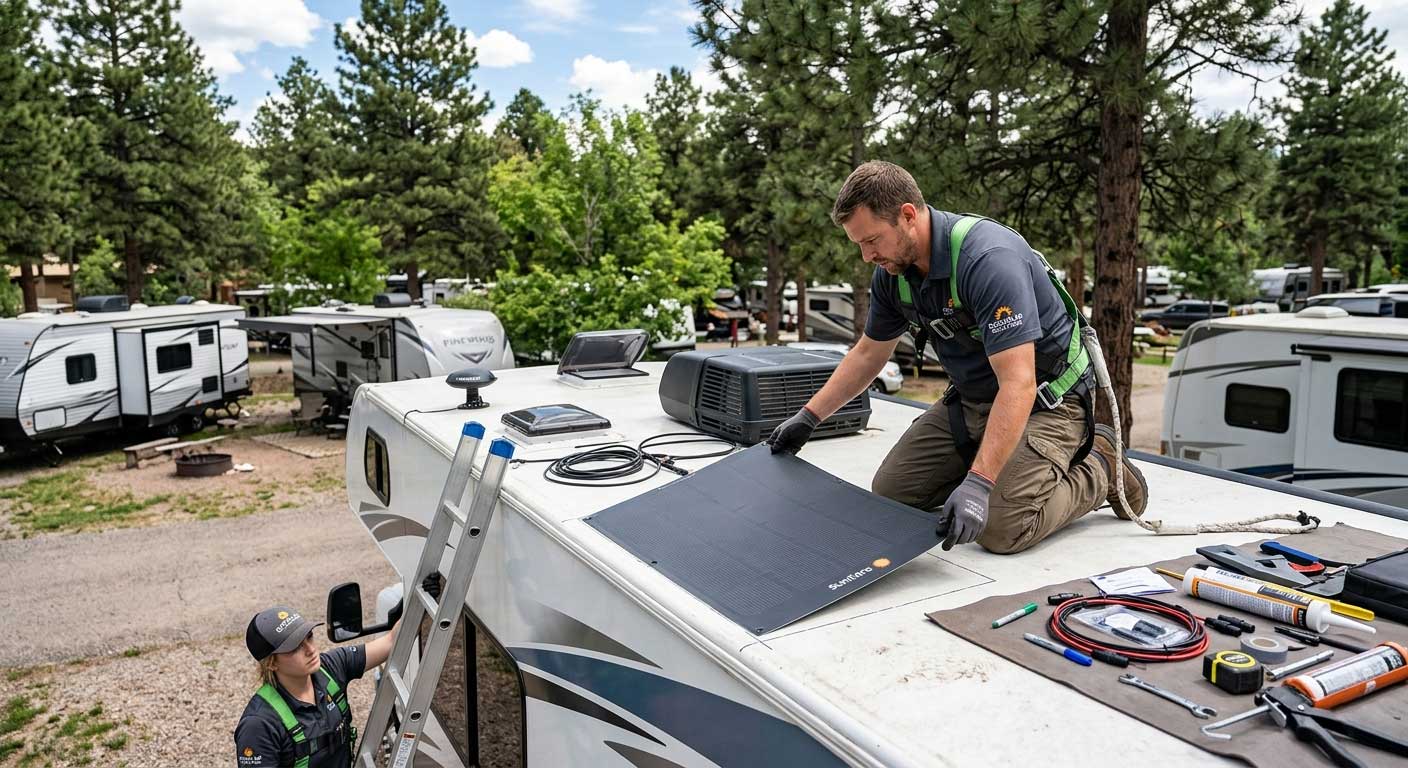
Tools and Materials I Normally Use
Every installer develops personal preferences.
These are the items I carry most often.
| Item | Purpose |
|---|---|
| Flexible Solar Panel | Power generation |
| MPPT Charge Controller | Battery charging optimization |
| MC4 Connectors | Electrical connections |
| UV-Resistant Cable | Outdoor wiring |
| Roof Cable Gland | Waterproof cable entry |
| Isopropyl Alcohol | Surface cleaning |
| Adhesive Sealant | Panel bonding |
| Multimeter | System testing |
I never install a panel before thoroughly cleaning the roof surface.
Dust, wax residue, and oxidation cause more installation failures than many people realize.
How to Install Flexible Solar Panel on RV Roof Step by Step
Step 1: Clean the Roof Surface
This step looks simple.
It’s not.
I’ve watched installers spend thousands on premium solar equipment and then rush through surface preparation.
The roof must be:
- Dry
- Clean
- Oil-free
- Dust-free
Use isopropyl alcohol after washing.
Allow the surface to dry completely.
Step 2: Test Panel Placement
Before applying adhesive, place the panel exactly where it will sit.
Check:
- Cable routing
- Roof obstructions
- Future maintenance access
- Sunlight exposure
Walk away.
Come back ten minutes later.
Look again.
You’d be surprised how often a better location becomes obvious.
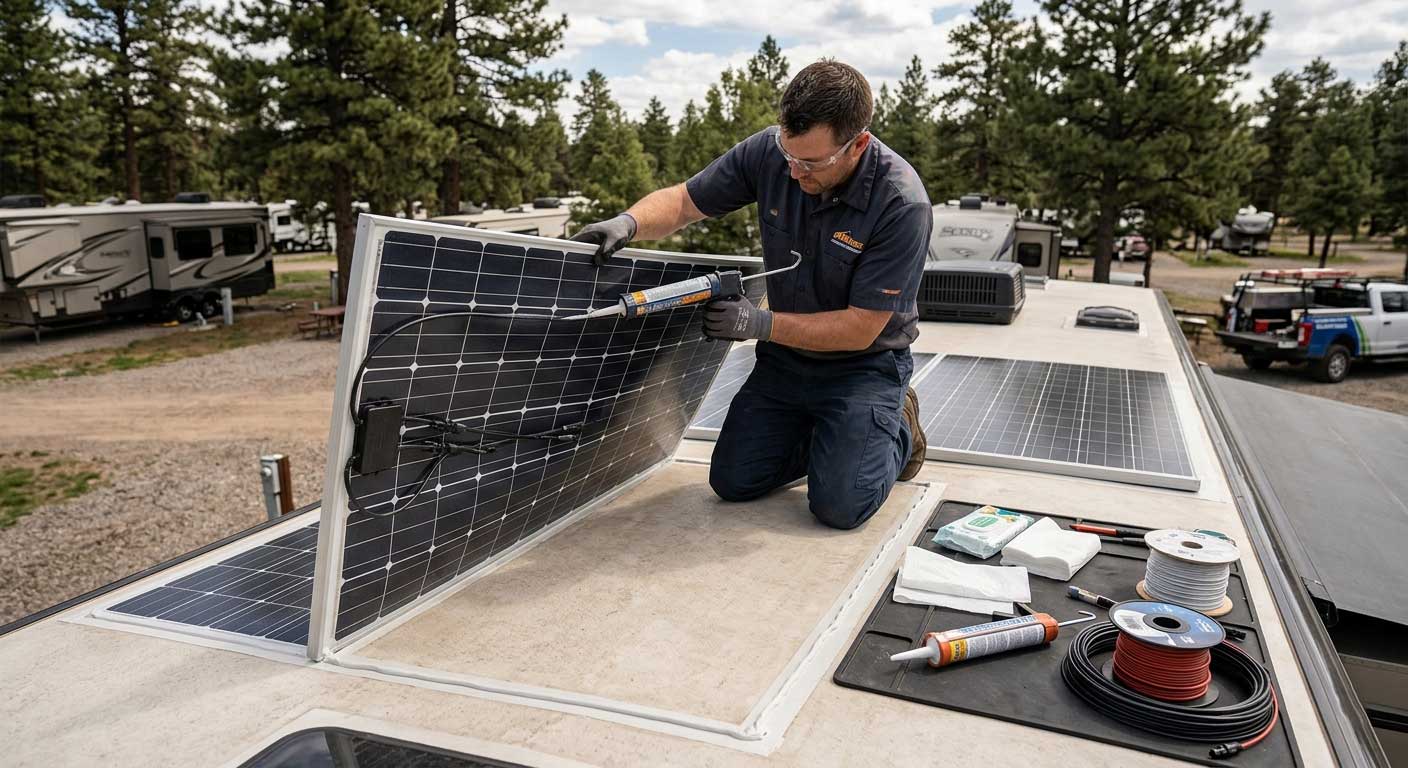
Step 3: Apply Approved Adhesive
For most semi-flexible RV installations, structural adhesive is preferred over drilling.
Benefits include:
- No roof penetrations
- Better waterproofing
- Cleaner appearance
Apply adhesive evenly according to manufacturer guidelines.
Avoid excessive amounts.
More adhesive doesn’t necessarily create a stronger installation.
Step 4: Route the Wiring
This is where many DIY installations become problematic.
Cable routing should:
- Avoid sharp edges
- Avoid standing water areas
- Remain protected from UV exposure
- Enter through waterproof cable glands
Every roof penetration should be properly sealed.
Water intrusion repairs cost far more than solar installation mistakes.
The Mistakes I See Most Often
The most common installation errors aren’t electrical.
They’re mechanical.
Mistake #1: Installing Directly Over Uneven Surfaces
Flexible doesn’t mean infinitely flexible.
Panels still require proper support.
Unsupported areas create stress points.
Mistake #2: Ignoring Ventilation
Many owners believe a panel should sit perfectly flush.
In reality, excessive heat buildup can reduce efficiency.
According to NREL research, solar module performance generally decreases as operating temperature rises.
Source:
https://www.nrel.gov
Mistake #3: Cheap Adhesives
I’ve inspected installations where discount adhesives failed within a year.
A premium adhesive costs little compared with replacing a detached panel.
H2 Real-World Performance After Installation
Customers often ask me:
“How much power should I expect?”
The answer depends on season, location, panel size, and battery condition.
A properly installed 200W flexible solar system may generate enough energy daily to support:
- LED lighting
- Ventilation fans
- Phone charging
- Laptop charging
- Water pumps
- Small appliances
Under ideal summer conditions, production can exceed expectations.
Cloudy weather tells a different story.
That’s normal.
Solar performance varies.
FAQ:How to Install Flexible Solar Panel on RV Roof?
Can flexible solar panels be glued directly to an RV roof?
Yes. Many flexible solar panels are specifically designed for adhesive mounting, provided the roof surface is properly prepared.
What is the best adhesive for flexible solar panels?
Marine-grade structural adhesives are commonly recommended because they provide strong bonding and weather resistance.
Do flexible solar panels need an air gap?
Some ventilation is beneficial because solar panel efficiency decreases as operating temperatures rise.
Can I walk on a flexible solar panel?
Most manufacturers advise against regular foot traffic. Occasional maintenance access may be acceptable depending on panel design.
How long does installation take?
Most RV installations can be completed within a day, though planning and wiring complexity may extend the project.
Visit the product page:Flexible Solar Panel
What I Would Do Differently Today
After years of RV solar projects, my approach has become simpler.
I spend less time focusing on panel specifications and more time evaluating installation quality.
The difference between a system that lasts two years and one that lasts ten often comes down to details hidden beneath the panel—surface preparation, cable routing, sealing, and mounting technique.
That’s why anyone researching how to install flexible solar panel on RV roof should view installation as more than attaching a panel. The real goal is building a solar system that survives thousands of highway miles, summer heat, winter storms, and years of daily use.
Related recommendations
-

How Much for Solar Panels?
237How much for solar panels? Discover average solar panel costs, what affects pricing, and how to estimate your home's solar investment with Bright Solar's expert guide.
View details -
How Much Is A Solar Panel For House?
189How much is a solar panel for house? Explore residential solar panel pricing, installation factors, equipment costs, and expert advice from Bright Solar.
View details -
how solar panels make electricity?
263Solar panels use photovoltaic cells to convert sunlight into DC electricity, which an inverter can convert into AC power for homes, businesses, batteries, or...
View details -
How to Compare Marine Flexible Solar Panels?
283Learn how to compare marine flexible solar panels beyond wattage. Discover real-world insights on durability, ETFE materials, saltwater resistance, and lifespan before buying.
View details