how do you mount flexible solar panels?
how do you mount flexible solar panels?
You mount flexible solar panels by cleaning the surface, positioning the panel for airflow and sunlight exposure, then securing it with industrial adhesive, VHB tape, screws, or mounting grommets depending on the roof material. Proper cable routing, heat management, and waterproof sealing matter more than most first-time installers expect.
The first flexible panel I mounted looked perfect for about six months.
Then summer arrived.
The adhesive softened on a black van roof outside Las Vegas, dust crept under the edges, and one corner started lifting at highway speed. The panel itself was fine. The mounting method was not.
That experience changed how I approach flexible solar installations. Most online tutorials oversimplify the process. In reality, mounting flexible solar panels is less about sticking something down and more about managing heat, vibration, expansion, and weather over time.
Why Flexible Solar Panels Need a Different Mounting Approach
Rigid solar panels rely on aluminum frames and brackets. Flexible panels behave differently.
They bend. They expand under heat. They sit closer to the roof surface. And because they are lighter, installers often underestimate wind forces at highway speed.
What Makes Flexible Panels Unique
| Feature | Flexible Panels | Rigid Panels |
|---|---|---|
| Weight | Lightweight | Heavy |
| Mounting Style | Adhesive or low-profile | Rack systems |
| Airflow Under Panel | Limited | Better |
| Roof Compatibility | Curved surfaces | Mostly flat surfaces |
| Wind Profile | Very low | Higher |
According to the U.S. Department of Energy, photovoltaic systems lose efficiency as operating temperature increases. That matters because directly mounted flexible panels typically run hotter than elevated rigid systems.
The mounting method directly affects heat buildup.
That’s why experienced installers obsess over airflow gaps.
Surface Preparation Matters More Than Adhesive Brand
This is where many installations quietly fail.
The strongest adhesive in the world cannot compensate for poor surface prep.
Before Mounting, Always:
- Remove wax and silicone residue
- Degrease with isopropyl alcohol
- Dry the roof completely
- Check for roof flex or weak spots
- Test-fit cable routing paths
I once inspected a van where the installer mounted panels directly over old oxidation residue on aluminum. After one rainy season, edge separation appeared everywhere.
The adhesive did not fail.
The surface failed.
Common Ways to Mount Flexible Solar Panels
There is no single “best” method. It depends on the vehicle, climate, and whether you want permanent installation.
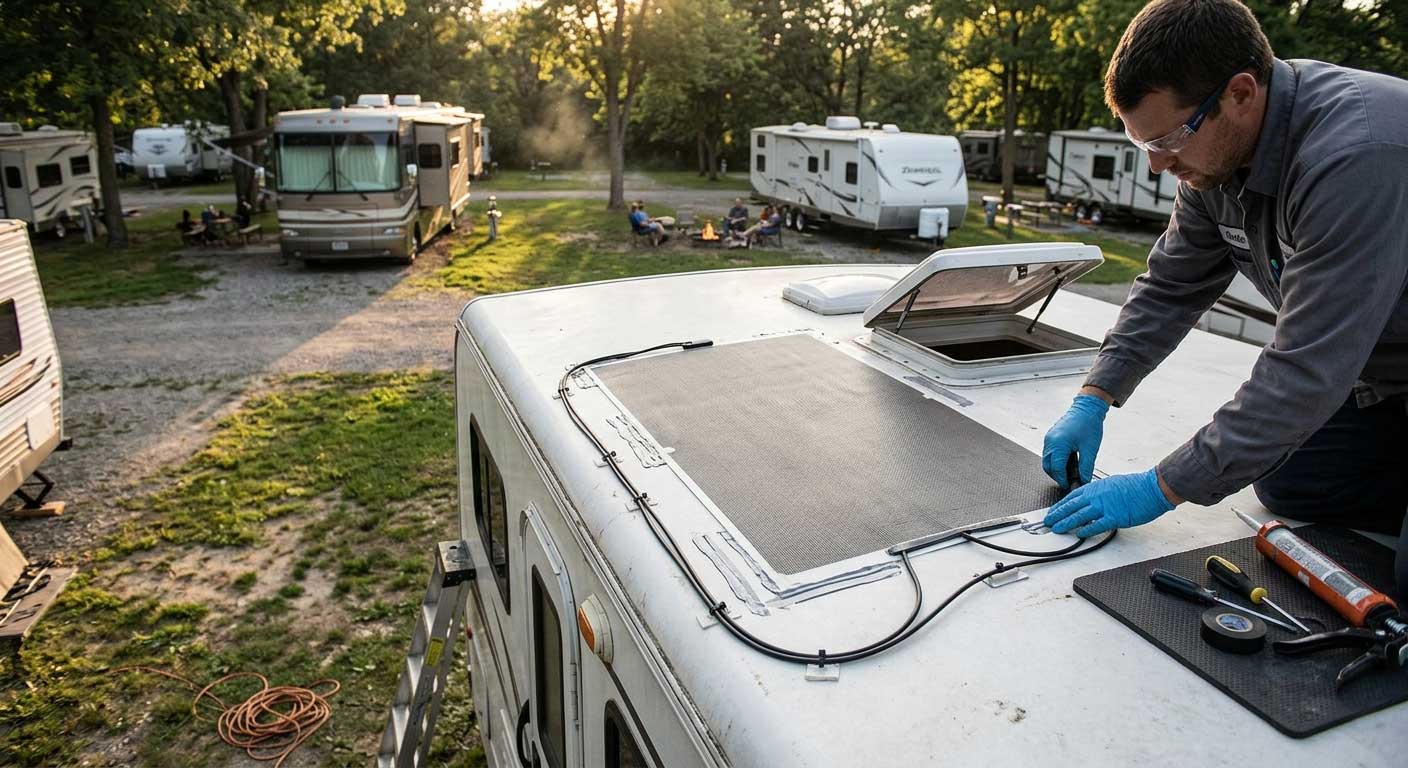
1. Industrial Adhesive Mounting
This is the most common method for RVs and vans.
Popular marine-grade adhesives include polyurethane-based products designed for vibration and outdoor UV exposure.
Advantages:
- No drilling
- Clean appearance
- Lower wind drag
- Better waterproofing potential
Disadvantages:
- Harder removal later
- Heat retention issues
- Surface prep becomes critical
2. VHB Tape Installation
High-strength acrylic foam tape is popular because it absorbs vibration well.
But heat changes everything.
On dark roofs exposed to desert temperatures, tape alone sometimes struggles long term unless paired with mechanical support.
3. Screw and Grommet Mounting
Some flexible panels include reinforced mounting holes.
This method provides stronger wind resistance but introduces roof penetrations.
If you drill into a van or RV roof, waterproof sealing becomes mandatory.
Use:
- Butyl tape
- UV-resistant lap sealant
- Waterproof cable glands
I still remember climbing onto a customer’s camper after heavy coastal rain. Water wasn’t entering around the cable gland — it was creeping through improperly sealed screw holes hidden under dirt buildup.
Tiny mistakes become expensive leaks.
Should Flexible Solar Panels Sit Flush Against the Roof?
Not completely.
That’s one of the biggest misconceptions online.
Why Airflow Gaps Matter
Flexible solar panels generate heat. Without airflow underneath, temperatures climb rapidly.
According to the National Renewable Energy Laboratory (NREL), solar panel efficiency decreases as module temperatures rise.
Better Mounting Practice
Whenever possible:
- Leave small ventilation channels
- Avoid full-surface adhesive coverage
- Use raised adhesive strips
- Prevent trapped moisture underneath
Even a few millimeters of airflow can noticeably reduce operating temperatures.
Best Roof Types for Flexible Solar Panels
Fiberglass RV Roofs
One of the easiest surfaces for adhesive installation.
They handle bonding well and resist corrosion.
Aluminum Van Roofs
Common in camper conversions.
Need careful thermal expansion consideration because metal expands aggressively in heat.
Marine Boat Decks
Flexible panels perform especially well here because low-profile mounting reduces wind resistance and vibration loads.

The Biggest Installation Mistakes I See Repeated
Most panel failures are not electrical.
They are mechanical or thermal.
Mistakes That Shorten Lifespan
| Mistake | Result |
|---|---|
| Mounting directly onto dark metal | Excessive heat |
| Blocking drainage paths | Moisture buildup |
| Using cheap sealant | Water leaks |
| Fully bonding entire underside | Thermal stress |
| Walking on unsupported cells | Microcracks |
One van owner in Arizona lost nearly 30% output after only two summers because the panel backside had warped from continuous heat saturation.
The panel still technically worked.
It just stopped producing meaningful power.
Real-World Wind and Highway Stress
Highway airflow creates uplift pressure most beginners underestimate.
At 70 mph, even lightweight panels experience constant flex stress.
How Professionals Reduce Wind Stress
- Round cable edges
- Keep panel edges fully bonded
- Avoid raised corners
- Use aerodynamic cable routing
- Add mechanical reinforcement in extreme climates
Marine installers learned this long ago. Offshore vibration destroys weak adhesive installations surprisingly fast.
How Long Mounted Flexible Solar Panels Last
Quality flexible panels mounted correctly often last between 5–15 years depending on:
- Heat exposure
- Roof material
- UV intensity
- Airflow
- Adhesive quality
- Maintenance habits
ETFE-coated panels generally outlast cheaper PET-coated models because ETFE resists UV degradation better.
The International Energy Agency (IEA) notes that heat remains one of the major long-term performance stressors for photovoltaic systems.
FAQ:how do you mount flexible solar panels?
Can you glue flexible solar panels directly to a roof?
Yes, but complete flat bonding without airflow can increase operating temperatures and reduce lifespan.
What adhesive is commonly used?
Marine-grade polyurethane adhesives and industrial acrylic systems are common for RV and van installations.
Do flexible solar panels need drilling?
Not always. Many installations use adhesive-only mounting methods.
Can flexible panels fly off while driving?
Improperly installed panels can lift at highway speed, especially if edges are poorly secured.
Should flexible solar panels be removable?
If future maintenance matters, semi-removable mounting methods may be preferable over permanent adhesive bonding.
Final Thoughts on How Do You Mount Flexible Solar Panels
Understanding how do you mount flexible solar panels properly has less to do with sticking panels down and more to do with controlling heat, stress, and moisture over years of outdoor exposure.
A clean-looking installation is easy.
A durable installation is harder.
The best systems balance secure attachment with airflow, waterproofing, and long-term thermal stability. That balance becomes especially important on RVs, vans, and boats where vibration and weather never really stop.
Done correctly, flexible solar panels can provide reliable off-grid power for years without adding heavy rack systems or excessive roof penetrations.
Done carelessly, even premium panels fail early.
Usually silently.
Sources
- U.S. Department of Energy — Solar Photovoltaic Technology Basics
- National Renewable Energy Laboratory (NREL) — MPPT Performance Research
- International Energy Agency (IEA) — PV System Performance and Temperature Effects
The prev: how to mount flexible solar panels to rv roof?The next: how do flexible solar panels work?
Related recommendations
-

How much are residential solar panels?
158Discover how much are residential solar panels and what affects total costs, including panel prices, installation factors, system size, and expert solar insights from Bright Solar.
View details -
How Much for One Solar Panel?
255How much for one solar panel? Discover real solar panel prices, wattage options, cost factors, and expert buying advice from Bright Solar.
View details -
how long does solar panel last?
177Learn how long does solar panel last with real lifespan data, degradation rates, maintenance tips, and Bright solar insights for long-term solar performance.
View details -
How many amps 200 watt solar panel?
335How many amps 200 watt solar panel produces depends on voltage and conditions. Learn current calculations, charging performance, and solar system sizing tips.
View details