Flexible Solar Panels RV: The Smarter Solar Upgrade for Modern Campers
Flexible solar panels RV systems are one of the most practical ways to generate reliable off-grid electricity without adding excessive roof weight or bulky mounting hardware. They install easily on curved camper roofs, reduce wind resistance, and help keep batteries charged during long-distance travel.
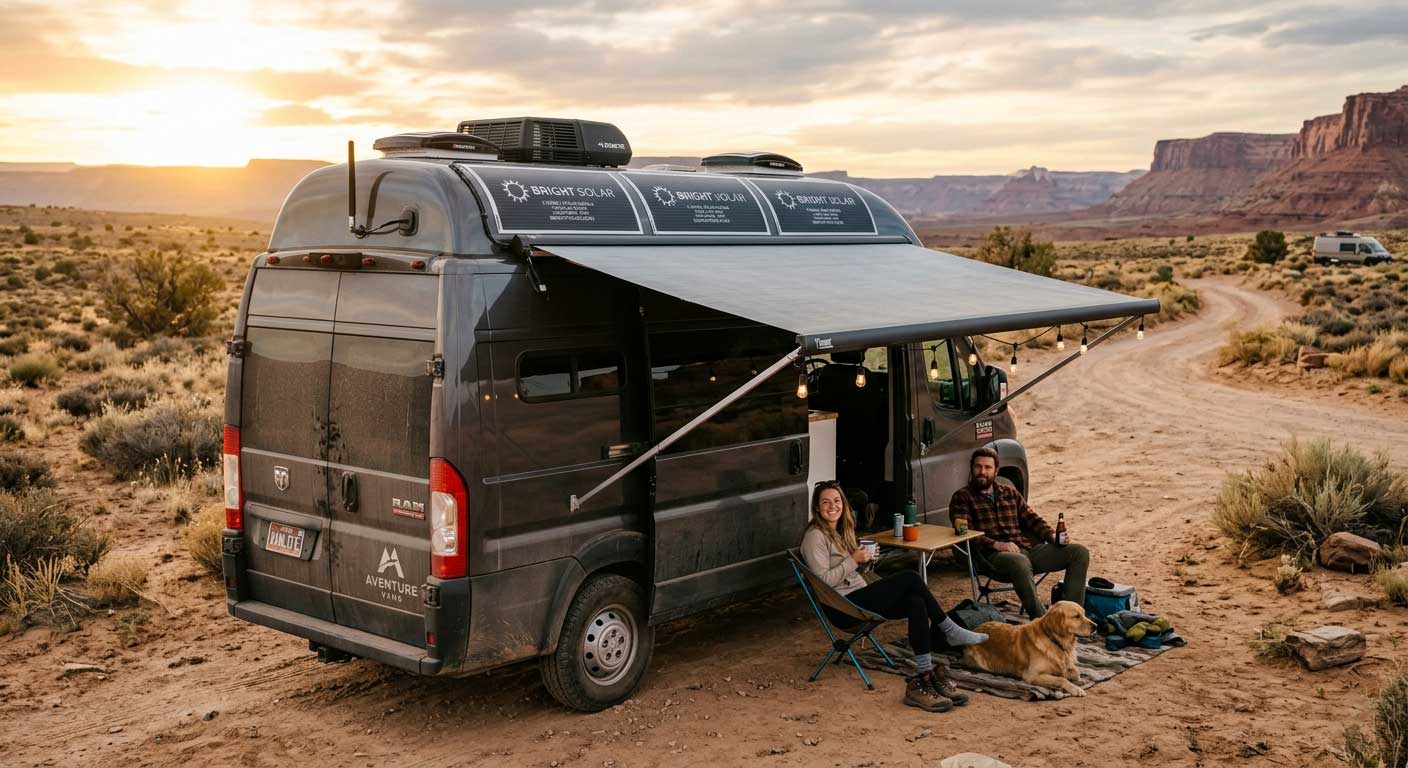
I stopped underestimating flexible RV solar somewhere outside Moab.
The campground was packed with overbuilt rigs carrying huge aluminum-framed solar arrays mounted several inches above the roofline. One afternoon, desert crosswinds started pushing hard through the canyon. You could actually hear some of the larger panel brackets humming in the gusts.
Meanwhile, a nearby Sprinter van with low-profile flexible panels sat almost silent.
That stuck with me.
RV solar discussions online usually obsess over wattage numbers. Real road travel teaches something different: vibration, roof weight, heat, clearance, and long-term reliability matter just as much as raw output.
And that is exactly why flexible solar panels RV owners are choosing today look very different from the rigid systems that dominated a decade ago.
Why RV Owners Are Moving Toward Flexible Solar Panels
RV travel has changed dramatically.
People are staying off-grid longer. Lithium batteries have become mainstream. Remote work turned weekend campers into full-time travelers almost overnight.
According to the RV Industry Association, more than 11 million U.S. households now own an RV, and off-grid camping demand continues rising across North America.
Source: RV Industry Association
https://www.rvia.org
That shift increased demand for lightweight, efficient solar systems that do not overload roofs or complicate installation.
Flexible solar panels RV users prefer today solve several practical problems:
- Lower roof weight
- Easier installation
- Better aerodynamics
- Reduced roof penetration
- Improved compatibility with curved surfaces
The weight difference alone is significant.
Some 100W flexible solar panels weigh under 5 pounds, while comparable rigid glass panels can exceed 15–20 pounds once brackets and rails are included.
That matters on older RV roofs.
Especially after thousands of highway miles.
How Flexible RV Solar Panels Actually Perform on the Road
Marketing photos rarely show the difficult part of RV solar.
Heat.
Road vibration.
Tree sap.
Low branches.
Thermal expansion.
Crosswinds at interstate speeds.
Those are the conditions that destroy weak installations.
I inspected a fifth-wheel trailer outside Phoenix last summer where two rigid panels had slowly loosened from roof vibration over several years. Tiny stress cracks had formed around the mounting points.
The owner originally blamed “cheap hardware.”
The bigger issue was constant roof flex combined with heavy elevated panels.
Flexible solar systems reduce some of that mechanical stress simply because they sit lower and weigh less.
That does not mean every flexible panel is durable. Many are not.
The difference usually comes down to materials.
What Separates Good Flexible RV Solar Panels from Cheap Ones
| Feature | Why It Matters |
|---|---|
| ETFE coating | Better UV and weather resistance |
| Monocrystalline cells | Higher charging efficiency |
| Lightweight design | Lower roof stress |
| Waterproof junction box | Improved outdoor durability |
| Flexible construction | Better fit on curved roofs |
According to the National Renewable Energy Laboratory (NREL), monocrystalline solar technology consistently delivers higher energy efficiency than older panel types.
Source: National Renewable Energy Laboratory
https://www.nrel.gov
That becomes important fast when RV roof space is limited.
Most travelers do not have room for oversized systems.
Efficiency matters more than panel count.
Flexible Solar Panels RV vs Traditional Rigid Panels
There is no perfect solar setup for every RV.
But there are clear differences.
Where Rigid Panels Still Perform Better
Rigid panels generally:
- Dissipate heat more effectively
- Last longer in stationary installations
- Maintain slightly better efficiency in extreme temperatures
That is why large residential rooftops still overwhelmingly use glass-framed systems.
Where Flexible RV Solar Panels Win
Flexible solar panels RV installations excel when:
- Roof weight matters
- Clearance is limited
- Aerodynamics are important
- Curved surfaces exist
- Simpler installation is preferred
One thing rarely discussed online is fuel economy.
A customer using a Bright Solar flexible RV setup tracked fuel consumption over nearly 8,000 miles after replacing raised rigid panels. The reduction was modest — roughly 3–4% — but measurable enough to notice during long interstate travel.
At highway speeds, airflow matters more than many people assume.
How Much Power Can Flexible RV Solar Produce?
Real-world output depends on:
- Sunlight hours
- Roof angle
- Weather
- Temperature
- Shading
- Battery efficiency
Still, practical estimates look like this:
| Solar Size | Typical Daily Output |
|---|---|
| 100W | 300–500Wh |
| 200W | 600–1000Wh |
| 400W | 1.2–2kWh |
| 600W | 2–3kWh |
Assuming:
- 4–6 peak sunlight hours
- MPPT charge controller
- Minimal shading
The U.S. Department of Energy notes that shading and excessive panel temperatures can significantly reduce photovoltaic performance.
Source: U.S. Department of Energy
https://www.energy.gov/eere/solar
That becomes painfully obvious under campground trees.
A small branch shadow can reduce charging far more than most new RV owners expect.
Where Flexible RV Solar Installations Usually Fail
The failures are usually predictable.
And most are preventable.
1. Poor Roof Preparation
Dirty or improperly cleaned surfaces reduce adhesive bonding strength.
One Nevada installer told me he could predict panel failures almost immediately just by checking whether installers cleaned oxidation off fiberglass roofs properly before mounting.
He was usually right.
2. Cheap Adhesive Materials=
Low-quality adhesives soften during extreme summer heat.
I have personally seen flexible panels shift position on dark RV roofs during Arizona heat waves.
That should never happen with proper mounting systems.
3. Excessive Heat Buildup
Flexible panels mounted directly against dark roofs can trap heat.
A small ventilation gap often improves longevity considerably.
Heat remains one of the biggest long-term challenges for flexible solar systems.
4. Incorrect Charge Controllers
PWM controllers waste available charging potential under changing light conditions.
A proper MPPT controller can improve energy harvesting noticeably.
According to Victron Energy technical resources, MPPT systems can significantly outperform PWM controllers under variable sunlight conditions.
Source: Victron Energy
https://www.victronenergy.com
Best Locations to Mount Flexible Solar Panels on RVs
Placement matters more than people realize.
Most Effective RV Roof Locations
| Mounting Area | Benefits |
|---|---|
| Front roof section | Reduced shading |
| Curved roof edges | Better fit for flexible panels |
| Flat center roof | Simplified wiring |
| Pop-top camper roofs | Lightweight compatibility |
Good layouts usually avoid:
- Air conditioner shadows
- Satellite obstruction
- Roof vent shading
- High foot traffic areas
The cleanest solar layout often outperforms the largest one.
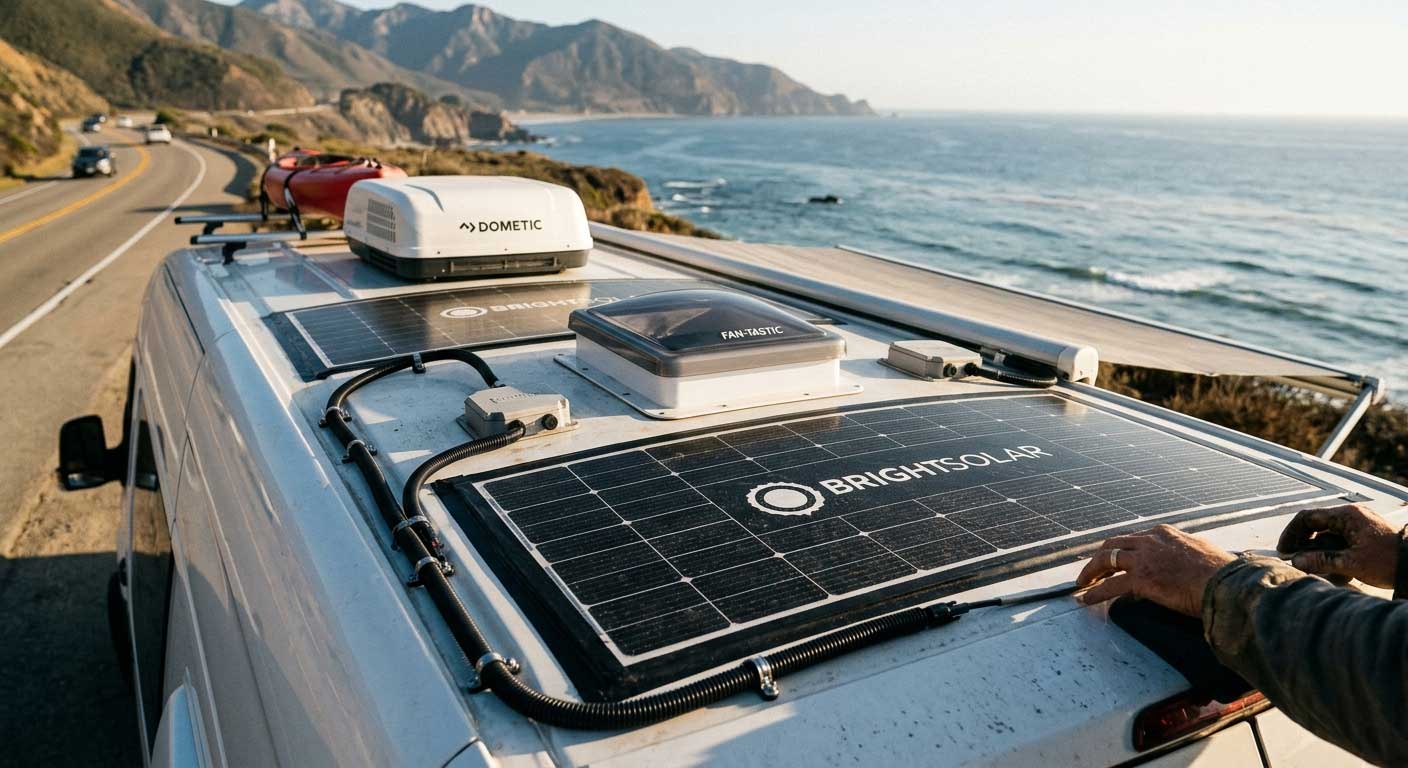
Choosing the Right Flexible Solar Panels RV System
The smartest RV solar systems are balanced systems.
Not oversized systems.
At Bright Solar, flexible RV solar products are designed specifically for:
- Lightweight roof installations
- Long-distance travel vibration
- UV resistance
- Off-grid charging stability
- Curved surface compatibility
Because real RV travel is messy.
Road dust gets everywhere.
Roofs flex.
Campgrounds create shade.
Heat builds up.
Storms appear suddenly.
Solar systems that survive those conditions consistently are usually engineered differently from systems designed only for laboratory performance charts.
FAQ: Flexible Solar Panels RV
Are flexible solar panels good for RVs?
Yes. Flexible solar panels RV systems are popular because they are lightweight, aerodynamic, and easier to install on curved camper roofs.
How long do flexible RV solar panels last?
High-quality flexible RV solar panels typically last between 5 and 15 years depending on heat exposure, installation quality, and maintenance.
Can flexible solar panels handle highway driving?
Yes. Properly installed flexible panels are designed to withstand highway wind exposure and vibration during long-distance RV travel.
Do flexible solar panels work on cloudy days?
Yes. Monocrystalline flexible panels continue producing electricity during cloudy weather, though with reduced output.
Can flexible solar panels charge lithium batteries?
Yes. Flexible RV solar systems commonly charge lithium battery banks when paired with compatible MPPT charge controllers.
Final Thoughts
Flexible solar panels RV owners use today are not simply thinner versions of traditional solar panels.
They are designed around mobility.
Curved roofs.
Road vibration.
Weight limitations.
Wind resistance.
Off-grid practicality.
Those realities completely change what matters in a solar system.
And after enough miles listening to elevated aluminum panel brackets shake against crosswinds somewhere between Utah and New Mexico, most RV travelers begin appreciating low-profile flexible solar very quickly.
Related recommendations
-

Flexible solar panels 300w: Lightweight High-Power Solar Solution for RV and Off-Grid Use
153Explore flexible solar panels 300w from Bright Solar. Learn power output, installation methods, applications, and why 300W flexible solar panels are ideal for RV, marine, and off-grid systems.
View details -
450w Solar Panels: Output, Size and Applications
182450w solar panels deliver high power in limited space. Compare output, efficiency, dimensions, wiring and applications for RV, home and off-grid solar systems.
View details -
flexible solar panels for car roof: Lightweight Solar Power Solution for Vehicles
199Discover flexible solar panels for car roof solutions with lightweight design, durable ETFE protection, and reliable solar power for EVs, camping cars, and outdoor travel.
View details -
73 MW Photovoltaic Project in California Now Online in Tulare County
279he 73 MW photovoltaic project in California, known as the Luciana solar project in Tulare County, has entered commercial operation. Built near Ducor, CA, it supplies clean power for over 20,000 homes, supports local jobs, and advances California’s...
View details