what is bifacial solar panel – Bright Solar explains in simple terms
If you work with solar projects or are planning a new PV plant, you’ve probably heard the term and wondered: what is bifacial solar panel and is it really different from a normal module? In short, a bifacial panel can generate power from both sides – the front and the back – by using light that hits the rear surface from the ground or surrounding structures.
Bright Solar has been focusing on this technology for high-efficiency projects, so let’s walk through how it works and where it makes sense, without getting lost in too much lab talk.
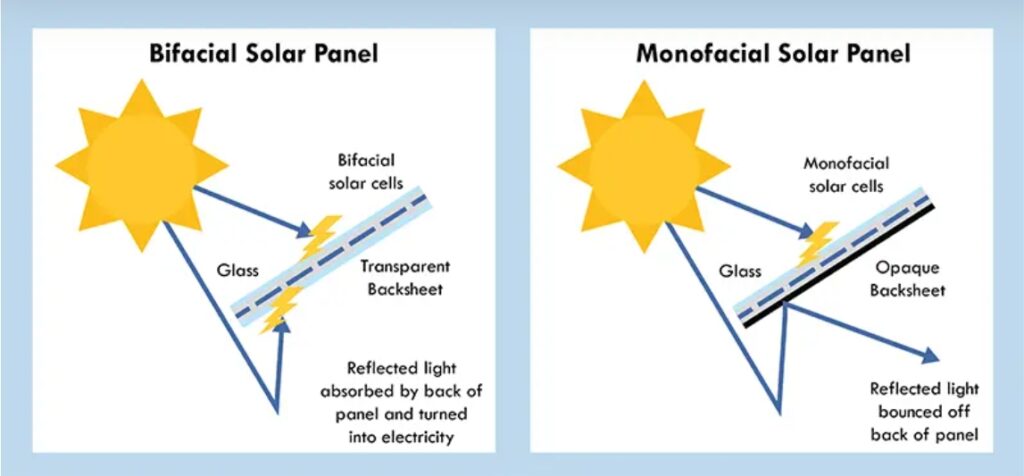
How a bifacial solar panel is built
To understand what is bifacial solar panel, it helps to look at the cell structure. Compared with a traditional single-sided panel:
- The front side uses a fine metal grid (often silver-based paste) to collect current, as usual.
- The back side does not use a solid aluminum layer. Instead, it has a partial Al/Ag grid, leaving open areas where light can enter.
- The whole laminate is usually sealed with glass or a transparent backsheet on the rear, so light can pass through and reach the back of the cells.
This design lets incident light from the back – reflected from the ground, white roofs, water, snow or nearby surfaces – enter the cell and be converted into extra electricity. In simple words, you increase the effective light-receiving area without adding more front-side surface.
Why operating temperature is lower
Another important piece of what is bifacial solar panel is temperature behaviour.
On the rear, many bifacial cells use a highly transparent SiNx (silicon nitride) layer that lets a portion of infrared light pass through instead of absorbing it. As a result, the module tends to run 5–9°C cooler than a conventional full-aluminum-back module under similar conditions.
Since crystalline silicon cells lose roughly 0.35–0.45% of power per °C of temperature rise, this lower operating temperature directly reduces temperature-related power loss and improves long-term energy yield.
Power generation gain: more than just a small bonus
So, what is bifacial solar panel giving you in terms of real numbers? The gain depends a lot on design and environment, but typical ranges are:
- Under the same nominal peak power and mounting position, bifacial plants often see 15–20% extra generation.
- If you increase module height and use high-albedo (high-reflectivity) ground, the gain can reach around 30%.
- With tilted single-axis tracking or other tracking devices, gains can even climb above 50% in well-designed systems.
This is why bifacial technology has become attractive for utility-scale and commercial rooftops where every extra kWh matters.
Flexible installation: including vertical mounting
A big part of what is bifacial solar panel is the flexibility in installation. Because the rear side also generates power, the module can benefit from:
- Different tilt angles, from almost flat to near vertical (0°–90°).
- Raised ground clearance, so more reflected light can hit the back.
- Light-coloured or reflective backgrounds (white gravel, concrete, snow, water, reflective membranes).
This makes bifacial modules suitable not only for classic ground-mount arrays, but also for:
- Vertical fences and solar noise barriers
- Solar curtain walls on buildings
- Greenhouse roofs and agricultural light-transmitting structures
- Highway sound insulation walls with integrated PV
In these cases, the panel is not just a power generator but also part of the structure or façade.
Some technical trade-offs on efficiency
To be honest about what is bifacial solar panel, it’s not perfect on every side. The rear efficiency is normally a bit lower than the front. Reasons include:
- The back grid still uses Al/Ag paste with wider lines and 30–40% coverage, so only part of the rear area can absorb light.
- Rear-side conversion efficiency is usually around 10–15%, while the front side can exceed 20%.
- When the full aluminum layer is changed to partial coverage to allow more light transmission, the front-side efficiency can drop slightly (often by about 0.2–0.5%).
Even with this trade-off, the combined front + back energy over the year is significantly higher than for a single-sided module.
Design factors that really matter
From a project point of view, what is bifacial solar panel performance influenced by? Key factors include:
- Reflective background – the lighter and more reflective the ground, the higher the rear-side gain.
- Module orientation and tilt – larger tilts and optimized spacing improve access to reflected and diffuse light.
- Height above ground – more space between module and ground lets the rear “see” a larger reflective surface.
- Use of tracking systems – adding single-axis tracking can further boost the energy harvest.
Bright Solar works with designers and EPC partners to model these factors digitally before installation, so the real-world gain of bifacial panels is not just a guess but part of the engineering.
In short, what is bifacial solar panel? It’s a double-sided, glass or transparent-back module that turns not only direct sunlight, but also reflected and scattered light, into extra energy. With proper design, Bright Solar bifacial solutions can deliver meaningful power gains and wider application possibilities, from classic solar farms to vertical fences and building façades.
Related recommendations
-

advantage of solar panel – Why More People Choose Bright Solar
281advantage of solar panel is clear: it cuts electricity bills, reduces carbon footprint and offers long-term clean power. Bright Solar explains how solar panels save money and protect the environment.
View details -
Project Newsland RV 2013: Our Real-World Test with the Bright Solar 100W Panel
169See how Project Newsland RV 2013 used a Bright Solar 100W flexible solar panel for real off-grid power. This case study shows the installation and results.
View details -
Zipper-style Flexible Solar Panels for Ship Shade Installation
182Customer Needs: The customer is a yacht solar panel installer in the local market, requiring long-term use at sea. They need lightweight yet stable solar panels that are easy to install and remove. Project Timeline: 2018Country: USACustomer Type: ...
View details -
Customized flexible solar panels for yacht customers
220Customer Needs: The customer required flexible solar panels suitable for their local yacht manufacturer clients. These panels needed to be lightweight, stable, and suitable for outdoor installation, as previous solar panels could not perfectly fit...
View details